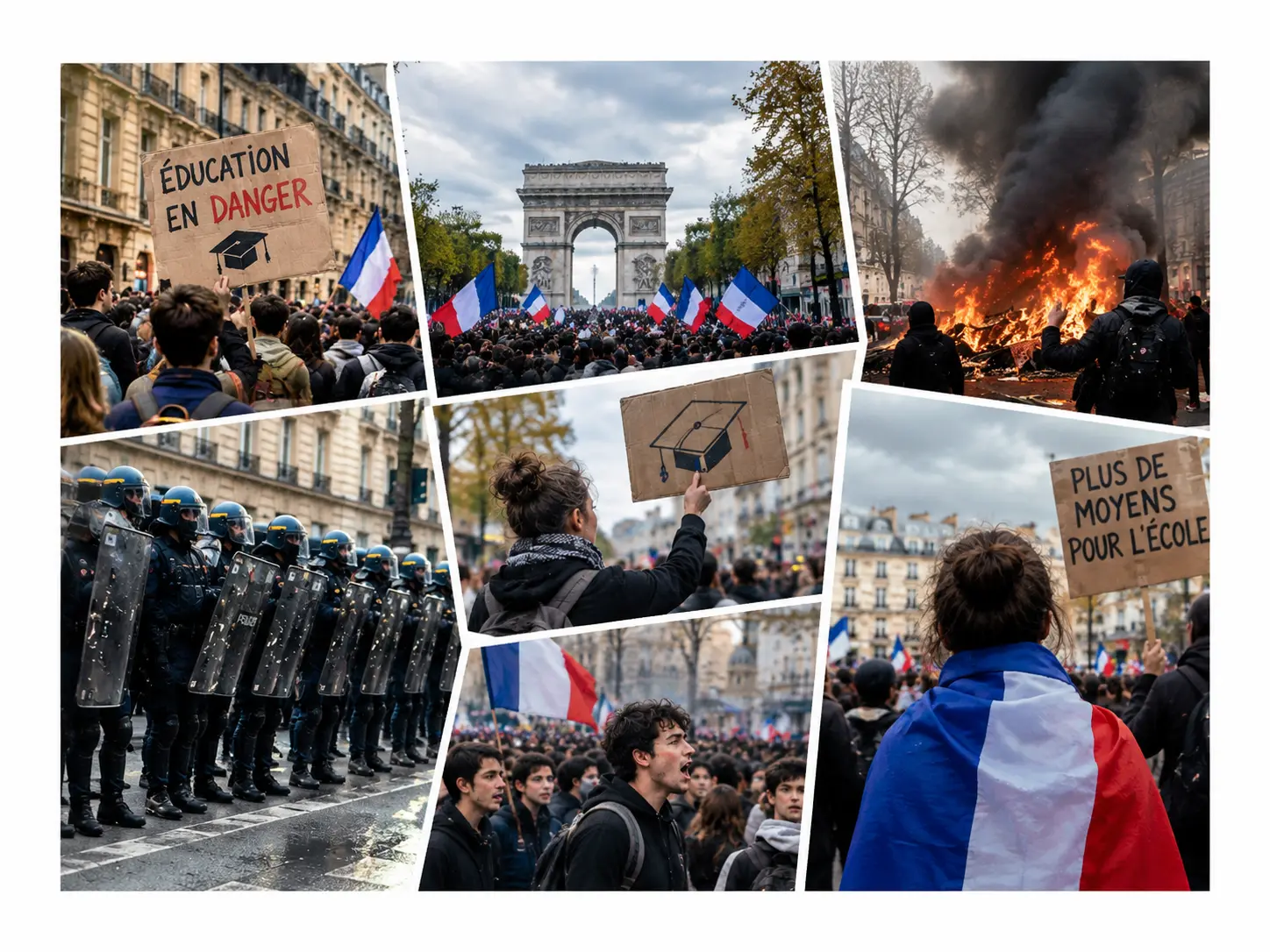
France Student Protests 2026: How It Started, What Students Want and What It Means for International Students
QUICK REFERENCE
| Protest Timeline |
6 October Turnout |
Next National Action |
Consultation Deadline |
|
3rd week
of protests since late September 2026
|
256,000–450,000
Reported turnout: Interior Ministry vs. unions
|
13 October 2026
Planned national strike and protest day
|
23 October 2026
Government online consultation closes
|
If you are studying in France, or planning to, you have probably seen the headlines, schools closed, marches in Paris, clashes with police, and university campuses blocked. What began as a local protest at one suburban lycée has become one of the largest youth mobilisations France has seen in years, according to the unions organising it.
This guide explains the situation as of 9 October 2026 in plain language. We rely on reporting from Time, CBS News, Connexion, Le JDD, La Gazette France, L'Étudiant and the student union L'Union étudiante, and we say clearly who is making each claim. Several numbers are disputed between the government and the unions, so we show both rather than choosing one.
Important
This is a fast moving situation. Figures and dates change daily. Always check your own university's official website and student email, and your embassy's travel advice, before travelling to campus or attending any gathering. This article is information, not legal advice.
1. The situation at a glance
KEY QUESTIONS ANSWERED
| Question |
Short Answer (as of 9 October 2026) |
| Who is protesting? |
Mainly lycée (high-school) pupils, joined by university students,
teachers' unions and parents' associations.
|
| Where? |
Protests reportedly began in the Paris region and have since been
reported in Rennes, Nantes, Bordeaux, Toulouse, Marseille,
Strasbourg, Lille, Lyon and other cities.
|
| Main issues |
Teacher shortages, overcrowded classes, dilapidated school buildings
and education funding. At universities, concerns also include
selective admission, tuition fees and housing aid.
|
| Is it violent? |
Most marches are reported as peaceful, but fires, clashes, tear gas,
arrests and serious injuries have also been reported.
|
| Are international students targeted? |
No source identified in the reporting reviewed indicates measures
specifically targeting international students. Indirect effects,
including closures, transport disruption and rescheduled classes,
remain possible.
|
| What's next? |
A national strike and protest day is listed for Tuesday, 13 October.
A government action plan and funding timeline are reportedly expected
before the end of October.
|
Note: This table reflects the information and dates supplied
for 9 October 2026. Verify current reporting and official announcements before
publication, particularly protest schedules, reported injuries and government commitments.
2. How it started?: A timeline
Sources differ slightly on the exact start date, describing it as late September (Time) or about two weeks before 6 October (Connexion). CBS News called 6 October the third week. The sequence below uses only dated, attributed reports.
PROTEST TIMELINE
| Date (2026) |
What Happened |
Source |
| Late September |
Pupils at Lycée Saint-Exupéry in Créteil, in the Paris region, mobilise over teacher shortages and a lack of resources. Blockades spread across Île-de-France. |
Time |
| 29 September |
A separate public-sector strike takes place. The CGT union reports 300,000 marchers, while Interior Ministry figures put turnout at approximately 200,000. |
Connexion |
| 30 September |
Reporting cites 625 arrests and 83 police officers and gendarmes injured in one day. |
L'Étudiant |
| 1 October |
Union étudiante reports 29 universities partially blocked. The government's 2027 budget bill is due to be presented. Union étudiante and Union syndicale lycéenne (USL) call a national demonstration for 6 October. |
L'Étudiant |
| 1 October |
Fires are reported at at least two schools, and a fire truck is reportedly burned at a lycée in Marseille. Reports citing the Interior Ministry describe nearly 2,000 detentions in one day. |
Time |
| 2 October |
Education Minister Édouard Geffray meets unions, student groups and parent associations and launches an online consultation. |
Time |
| Early October (Undated) |
Prime Minister Sébastien Lecornu calls a crisis meeting and announces five initiatives, with a timeline and funding plan promised before the end of the month. |
Time |
| 5 October |
More than 160 of Île-de-France's 468 public lycées are reported closed, according to regional president Valérie Pécresse. |
Sortiraparis |
| 6 October |
A national day of action takes place. The Interior Ministry reports approximately 256,000 marchers nationwide. USL reports around 1,800 lycées affected, while the Ministry reports 900 with partial or total closures by midday. |
Connexion; Time |
| 7 October |
Mediapart reports that administrative closures of universities are increasing. |
Mediapart |
| 8 October |
During what is described as "Act IV", the Interior Ministry reports 71,500 protesters nationwide, including 24,500 in Paris, 504 arrests and 48 police officers and gendarmes injured. Geffray announces 3,000 replacement teachers. |
La Gazette France |
Editorial note: Figures and event descriptions are based on the supplied timeline. Crowd estimates, closure counts and arrest figures may differ between authorities, unions and media outlets. Verify the original reports before publication.
Student unions have borrowed the term "Acts" from the 2018 gilets jaunes movement to number their days of action (Connexion). The government is reported to be worried that this movement could merge with other protests, including union action over the 2027 budget.
3. Why it started?: the grievances
In schools (lycées)
• Missing teachers: Education Ministry data cited by Time show nearly 10% of teaching hours went untaught in public secondary schools in 2024–25, about 7.5% because no replacement was found.
• Overcrowding: Pupils describe classes of 30 to 35 (Le JDD, Time) and too few chairs.
• Buildings: Leaks, too few toilets, crumbling ceilings, and heat during summer heatwaves (Time, CBS, Le JDD). One Saint-Denis protester told CBS of falling ceilings and rats; that is the protester's account.
• Timetables and the 2019 reform: Pupils report days from 8 a.m. to 6 p.m. and blame the 2019 lycée reform; mental-health concerns are also raised (Le JDD).
• Parcoursup: Pupils say the university application platform creates stress and mistrust (Time, Le JDD).
In higher education
• The Union étudiante and FAGE (student federation) say universities lack funding for staff, buildings and student aid (L'Étudiant, 1 Oct).
• They oppose a cut to housing aid (APL), higher tuition fees and a possible APL freeze in 2027 (L'Étudiant, 1 Oct).
• The Union étudiante and USL want selection at university entry and for master's programmes abolished (Le JDD, 8 Oct).
The political backdrop
CBS News describes the government as in political deadlock ahead of the 2027 presidential election. Unions blame budget cuts. The government's own framing differs: Connexion reports the government claims far left groups, including La France Insoumise, organised the protests, while pupils say police aggression is a main cause of the violence. We report both claims as claims, we could not verify either independently. Education Minister Geffray has said the movement began with local demands and has no national list of demands (Time).
4. What protesters are demanding?
KEY DEMANDS
Editorial note: Some links lead to a publication's homepage or a related report rather than the exact original article. Verify the specific claims and petition figures against the original sources before publication.
The two largest groups have jointly published a platform titled "Les revendications de la jeunesse, dix mesures d'urgence" (Le JDD). We could not find a full public breakdown of the "10 billion" figure, so we do not state what it would fund.
5. The numbers: Who says what?
Turnout, arrests and injuries are reported differently depending on the source. Treat all of these as claims by the named body.
6. What the government has done so far?
• Online consultation: Education Minister Geffray launched a platform for pupils to share grievances (anonymously allowed), open until 23 October, to feed a "national report" (Connexion, Time).
• "High school time": a half-day of debate for staff, then pupils, after classes resume (Time).
• Replacement teachers: 3,000 to be deployed to the most affected schools "in the hours and days to come", rectors may recruit beyond usual limits, adding "a few hundred" more. Geffray cited 114 lycées as "red" and 400 as "orange" (La Gazette France, 8 Oct).
• Action plan: Geffray promised a measurable action plan with a timeline; Lecornu said a timeline and funding plan would come before the end of October (Time, Le JDD).
• Budget: a draft 2027 budget plan to charge enrolment fees for certain vocational and preparatory classes at grandes écoles was dropped (Connexion).
• Order and justice: Lecornu condemned the violence, defended police and said "justice must be served". President Macron said in Madrid that he understood young people's anger but that no grievance justified violence (Time).
Student representatives have given mixed reactions. After meeting ministers on 8 October, two said they were dissatisfied, while Renouveau lycéen cited "advances" (La Gazette France). CBS reported that the government had yet to offer "meaningful concessions" as of 6 October. The Union étudiante says mobilisation will continue until the movement gets its "10 billion".
7. Violence, arrests and investigations
Most marches have been reported as peaceful, but serious incidents have occurred. These are reported with attribution:
• A 15 year old in Lens lost a hand after picking up a grenade (Time, CBS). A police union source said it appeared to be a sting ball grenade fired by riot police, the prefect declined to comment on the injury. Local investigations were announced.
• A 14-year-old in Saint-Ouen-l'Aumône reportedly suffered a jaw fracture from a tear gas grenade, per the teen's lawyer (BBC via CBS).
• A teenager was hospitalized after a mortar fire incident in Noisy-le-Grand (Connexion).
• Fires at schools, a burned fire truck in Marseille, and a vandalised lycée near Bordeaux with damage estimated by its principal at several hundred thousand euros (Time, La Gazette France).
• The police oversight body IGPN opened 10 investigations, including one into an officer in Metz accused of sexual assault of a teenage protester during an arrest (Connexion).
• A municipal police chief in Port-de-Bouc was suspended after a video showed him accelerating toward young people (La Gazette France).
Politicians disagree on interpretation. Green Party leader Marine Tondelier called the policing "extraordinary repression", PM Lecornu rejected what he called "false reports" about officers' conduct. Both are positions, not established findings.
8. What is happening in universities?
The movement began in lycées, but universities joined from 1 October.
• 1 Oct: Union étudiante reported 29 universities partially blocked (L'Étudiant).
• 6 Oct: Union étudiante said 90% of universities were mobilised and 57+ sites blocked by 9:40 a.m., with 27 universities under preventive administrative closure. These are the union's own figures. Connexion repeats the 57 site number without naming a source.
• 7 Oct: Mediapart reported that administrative closures of universities are multiplying.
• Higher Education Minister Philippe Baptiste was reported by AEF to fear an "embrasement" (flare-up) ahead of 6 October.
• Paris 8, Nanterre and Paris 1 (Tolbiac) had no announced closure for 6 Oct as of 5 Oct, though disruption was not ruled out; Paris 8's Saint-Denis campus had been blocked on 1 Oct (Sortiraparis).
The government has not, in the sources we found, published a consolidated list of closed universities. Closures are decided locally and can change overnight.
9. Does it affect international students?
Short answer: not directly, but you may notice it. We found no official announcement of changes to visas, residence permits (OFII/prefecture), Campus France procedures or international student rules linked to these protests.
Possible indirect effects
• Classes and campuses: blockades and administrative closures can cancel or move classes online. Blockades do not always stop all teaching, and some courses continue remotely (L'Étudiant).
• Transport: six metro stations were reported closed for the 6 October march, and planned works affected RER/Transilien from 5–11 October (Sortiraparis). Expect disruption on strike days.
• Timetables and exams: we found no published nationwide exam changes. Rescheduling, if any, is decided by each university.
• Safety: clashes and tear gas have occurred around marches. Avoid crowds and police cordons.
Where international students appear in the debate?
The Union étudiante lists opposition to differentiated tuition fees for international students among its causes and says a petition has more than 20,000 signatures (union source, claim not independently verified). Housing aid (APL) is also a protest theme. For context from earlier Dimensions France coverage: from September 2026 new non-EU students pay differentiated fees (about €2,895 bachelor's, €3,941 master's, €398 doctoral, with exemptions up to 30%), and from 1 July 2026 CAF/APL housing aid is limited to EU/EEA/Swiss nationals and French government scholarship holders. We could not confirm from the protest sources whether the unions' APL demands refer to that specific measure, so we do not link them.
Important
Foreign nationals in France are subject to French law like everyone else. Taking part in a gathering that results in an arrest or a criminal conviction could complicate a residence permit renewal. If you plan to attend a lawful, declared demonstration, stay peaceful, carry your ID and residence document, and seek legal advice if in doubt. This is general information, not legal advice.
10. If you are already studying in France: what to do?
• Check your university's website, ENT/Moodle and student email every morning for closure or remote class notices.
• Keep proof of enrollment (certificat de scolarité) and attendance records, in case your prefecture asks at permit renewal.
• Do not skip scheduled exams unless the university has officially postponed them. Ask your administration in writing if unsure.
• On strike days (next: 13 October), plan extra travel time; check RATP, SNCF and Île-de-France Mobilités before leaving.
• Avoid march routes, closed metro stations and areas near blockaded schools.
• Keep your passport, residence permit or VLS-TS and emergency contacts with you; save your embassy's contact details.
• Keep deadlines in mind: OFII validation, permit renewals and CVEC continue regardless of protests. Prefectures and OFII have not announced delays in the sources we found, so check your appointment email.
• Stay calm about misinformation. Videos and figures circulate quickly; rely on official or major outlet reporting.
Dimensions France Tip
If your classes move online for several days, ask your programme coordinator how attendance will be recorded, and keep a copy of the official notice.
11. What is coming next?: the calendar
WHAT HAPPENS NEXT?
Editorial note: These dates and planned events reflect the supplied source material. Verify schedules and announcements with the original sources before publication, as planned protests and government timelines can change.
12. What could happen next?: three scenarios
These are our analysis, not predictions. None of the following is confirmed.
• De-escalation: If the funding plan due by end of October is seen as concrete, and replacement teachers arrive visibly, mobilisation could fade. The Union étudiante has said it will continue until it gets its "10 billion", so this depends on what is offered.
• Prolonged mobilisation. If the plan is judged insufficient, repeated action days and university blockades could continue through November, with more administrative closures.
• Convergence. The government is reported to fear the student movement merging with budget-related union action and other protests (Connexion). A wider strike would raise transport disruption.
Background
French universities saw large blockades in 2018 over admissions reform and Parcoursup. Those movements ended without the reform being withdrawn, so history does not give a clear template.
For international students, the most likely effect in every scenario is short-term disruption rather than changes to your legal status.
13. If you are applying for 2027
• Campus France and university application calendars are not reported to have changed. Keep submitting documents on time.
• Higher education funding and fee debates may feature in the 2027 budget. Always check each university's current tuition page before paying.
• Check your target university's recent status. A few days of closures should not affect an intake in 2027, but delays to admin offices are possible.
• France remains open to international students. We have not seen any measure in this movement aimed at restricting them.
Frequently asked questions
1. Are the protests dangerous for international students?
Most marches are reported as peaceful, but there have been clashes, tear gas and injuries. Avoid crowds and cordoned areas, and follow official guidance.
2. Will my university close?
Closures are decided locally, sometimes at short notice. Check your university's official channels every morning.
3. Will protests affect my visa or residence permit?
We found no official announcement of changes. Keep your enrolment and attendance documents, and respect your appointment dates.
4. Can I take part in a protest as a foreign student?
Taking part in a lawful, declared demonstration is generally permitted, but arrests or convictions can have consequences for permits. Seek legal advice if unsure.
5. When is the next big protest day?
Tuesday 13 October 2026, a national strike and protest day (La Gazette France). Dates may change.
6. Is this related to the new tuition fees for international students?
The Union étudiante lists opposition to differentiated fees among its causes. Wider protests focus mainly on schools, selection and funding.
7. Where can I get reliable updates?
Your university, your rectorate and prefecture, major news outlets, and the Dimensions France team.
Final thoughts
This is a young people's movement over school conditions and education funding, and it has grown quickly. For international students, the practical impact so far is disruption rather than policy change. Stay informed, stay safe, and keep your documents ready. We will update this article as the situation develops.
Dimensions France
Worried About Your Studies in France?
Our advisors can help you navigate university applications, student visas,
accommodation, and everything you need to settle into student life in France.
Contact Dimensions France