The Grand Paris Express: France's New Metro Network Explained (2026 Guide)
QUICK REFERENCE
| New Metro Track |
New Stations |
Daily Riders at Completion |
Already Operating Since |
| 200 km |
68 |
~3 million |
June 2024 (Line 14) |
If you've seen construction cranes and tunnelling sites scattered across the Paris suburbs, you've already seen the Grand Paris Express taking shape. This is the biggest transport project in France, and one of the biggest in Europe, and it's specifically going to reshape how students get to campus, to internships, and to the airport. Here's what it actually is, based on official figures from the Société des Grands Projets (SGP), the state owned public body responsible for building it.
1. What Problem Is It Actually Fixing?
Paris's existing metro and RER network is a hub and spoke system: almost every line radiates outward from the city centre. That works well if you're travelling between the suburbs and central Paris, but it works badly if you're travelling between two suburbs, which today usually means riding into Paris and back out again, adding significant time and piling extra passengers onto already saturated central lines like RER A and RER B.
The Grand Paris Express is designed to solve this directly, by building an orbital, ring shaped network that connects suburb to suburb without passing through Paris at all, according to the SGP's own description of the project. It's also aimed at areas that grew rapidly but were never given transport to match, the Paris-Saclay University and research cluster being the clearest example: home to Université Paris-Saclay, École Polytechnique, Centrale Supélec, HEC Paris, and dozens of research institutes, yet historically reachable only by in frequent buses or an overcrowded RER B.
2. The Official Numbers
According to the Société des Grands Projets, the completed network will consist of:
- 200 km of new, fully automated metro track, across four new lines (15, 16, 17, 18) plus the extension of an existing one (Line 14).
- 68 new stations, of which 80% will connect directly to the existing Paris metro, RER, or tram network.
- Approximately 3 million passengers expected to use the full network daily once it's complete.
- 42 of the 68 stations will serve priority urban policy neighbourhoods, areas the SGP specifically flags as historically underserved by transport.
- A carbon benefit estimated by the SGP at a minimum of 14.2 million tonnes over the 20 years following full commissioning.
- Full accessibility: the entire network is being built to be fully accessible to people with disabilities.
3. Line by Line: What's Actually Open, and What's Coming
This is the part most articles get vague about, so here's exactly where each line stands, as of September 2026, based on SGP and Île-de-France Mobilités scheduling:
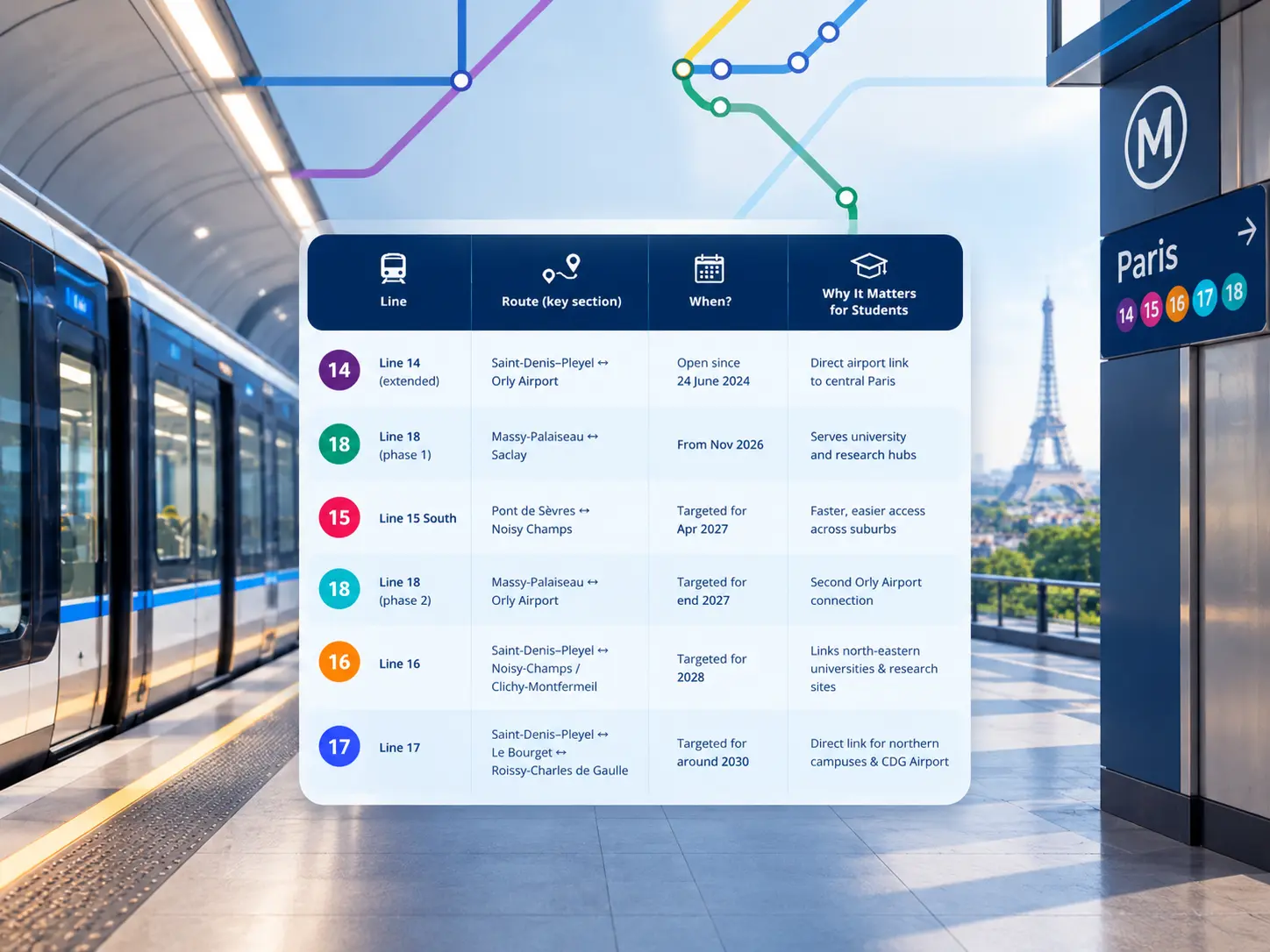
Line-by-Line Status: What Students Need to Know
| Line |
Route |
Status (as of Sep 2026) |
Why It Matters for Students |
| Line 14 (extended) |
Saint-Denis–Pleyel ↔ Paris Orly Airport |
Open since 24 June 2024 |
Already gives a direct, fast metro link between Orly Airport and central Paris |
| Line 18, phase 1 |
Massy-Palaiseau ↔ CEA Saint-Aubin (Saclay) |
Expected to open 30 November 2026 |
Directly serves Université Paris-Saclay, École Polytechnique, and the wider Saclay research and student cluster |
| Line 15 South |
Pont de Sèvres ↔ Noisy Champs (16 stations) |
Delayed twice; now targeted for April 2027 |
Cuts a journey that currently takes about an hour down to roughly 35 minutes, serving 2 million residents directly |
| Line 18, phase 2 |
Massy-Palaiseau ↔ Paris Orly Airport |
Targeted for end of 2027 |
Adds a second direct Orly Airport connection alongside Line 14 |
| Line 16 |
Saint-Denis–Pleyel ↔ Noisy-Champs / Clichy-Montfermeil |
Targeted for 2028 |
Links north-eastern suburbs, including several university and research sites, without routing through central Paris |
| Line 17 |
Saint-Denis–Pleyel ↔ Le Bourget ↔ Roissy-Charles de Gaulle Airport |
Targeted for around 2030 |
Will give the Paris region's northern university campuses and CDG Airport a direct metro link for the first time |
Dimensions France Tip: Expect the Dates to Keep Moving
Line 15 South alone has been pushed back three times, from late 2025 to summer 2026, then late 2026, and now April 2027. Treat every date on this list as the current official estimate, not a guarantee, and check the SGP's live schedule (grandparisexpress.fr) before making firm plans around a specific opening.
4. The Real Cost Story: Two Very Different Official Numbers
Worth knowing, because it occasionally makes headlines: there isn't one agreed cost for this project, there are two, from two different official sources.
Grand Paris Express: What Will It Cost?
| Source |
Cost Estimate |
|
Société des grands projets
(project's own target, confirmed November 2025)
|
€36.1 billion, quoted in 2012 economic conditions; unchanged as an official target since 2021.
|
|
Cour des Comptes
(France's national audit court; most recent comprehensive review)
|
Approximately €83.9 billion when the full lifetime cost, including financing, is taken into account, compared with an earlier 2023 estimate of about €39.7 billion.
|
The gap reflects a genuine, ongoing disagreement, the SGP's figure is its internal target cost in fixed 2012 euros, while the Cour des Comptes' estimate accounts for inflation, financing charges, and costs it argues the SGP's own figure leaves out. Neither number affects student fares or ticketing, which run through the region's standard Navigo system, but it's a legitimate part of the project's story if you want the full picture.
5. How This Actually Benefits International Students
Direct access to Paris-Saclay, finally. If you're studying at Université Paris-Saclay, École Polytechnique, CentraleSupélec, or any of the dozens of institutions in the Saclay cluster, Line 18's first section (expected 30 November 2026) is the single biggest change: a direct metro link where students previously relied on shuttle buses and one overloaded RER line.
Suburb to suburb journeys without detouring through Paris. If you live in an affordable outer suburb and study or intern in another one, for example commuting to a business district like La Défense or a tech hub like Aulnay-sous-Bois's growing Val Francilia campus, the new orbital lines mean you no longer have to ride into central Paris and back out, often cutting real commutes by 20 to 30 minutes each way, based on the SGP's own published journey time comparisons.
Better airport connections for arrivals, family visits, and travel. Line 14 already gives a direct metro connection to Paris Orly Airport since 2024, useful the day you land and every time family visits. Line 18's second phase will add a further Orly connection by late 2027, and Line 17 will eventually give the Paris region its first direct metro line to Roissy-Charles de Gaulle Airport, around 2030.
More affordable housing becomes genuinely commutable. As new stations open, neighbourhoods that were previously a long, inconvenient trip from campus become a short, direct one, which matters directly for student budgets: it widens the realistic radius of places you can afford to live without sacrificing your commute time.
A fully accessible network from day one. For students with mobility needs, every one of the 68 new stations is being built to full accessibility standards, unlike large parts of the older Paris metro, where step free access is still the exception rather than the rule.
6. What This Means for You Right Now
If you're arriving for the current academic year, most of the network you'll actually use today is still the existing Paris metro and RER, plus the already open Line 14 extension to Orly. If your programme is based at Paris-Saclay, keep a close eye on Line 18's opening date specifically, an initial section is expected by the end of November 2026, which would be a genuine, immediate improvement to your daily commute if your term is still running when it opens. For everyone else, treat 2027 to 2030 as the period when the bulk of the remaining network, including Line 15 South and eventual CDG Airport access, gradually comes online.
Quick FAQ
Do I need a special ticket for the Grand Paris Express? No. The new lines use the same Navigo card and standard Île-de France Mobilités fare system as the rest of the Paris region's public transport.
Is any part of the Grand Paris Express open right now? Yes, the Line 14 extension between Saint-Denis-Pleyel and Paris Orly Airport has been open since June 2024. The first entirely new line, Line 18, is expected to open its initial section by the end of November 2026.
Will this replace the existing Paris metro? No, it's additional. The Grand Paris Express adds new orbital lines around the existing hub and spoke network, roughly doubling the size of the current system rather than replacing any part of it.
Why do the opening dates keep changing? This is a genuinely large civil engineering project, over 100 km of tunnel have already been dug, and delays are common on projects of this scale worldwide. The SGP publishes its current schedule at grandparisexpress.fr, which is the most reliable source for the latest dates.
Final Thoughts
The Grand Paris Express is genuinely one of the more consequential things happening to daily life in the Paris region right now, and it's happening on a timeline that overlaps directly with your studies. If your university, internship, or flat search touches Paris-Saclay, an outer suburb, or either airport, this project isn't background infrastructure news, it's a direct, practical change to how you'll actually get around over the next few years.
DIMENSIONS FRANCE
Choosing a City or a Flat Around Your Commute?
Dimensions France can help you weigh housing and campus location decisions
against what’s actually opening, and when, rather than relying on guesswork.
Contact Dimensions France
Dimensions France
www.dimensionsfrance.com
contact@dimensionsfrance.com