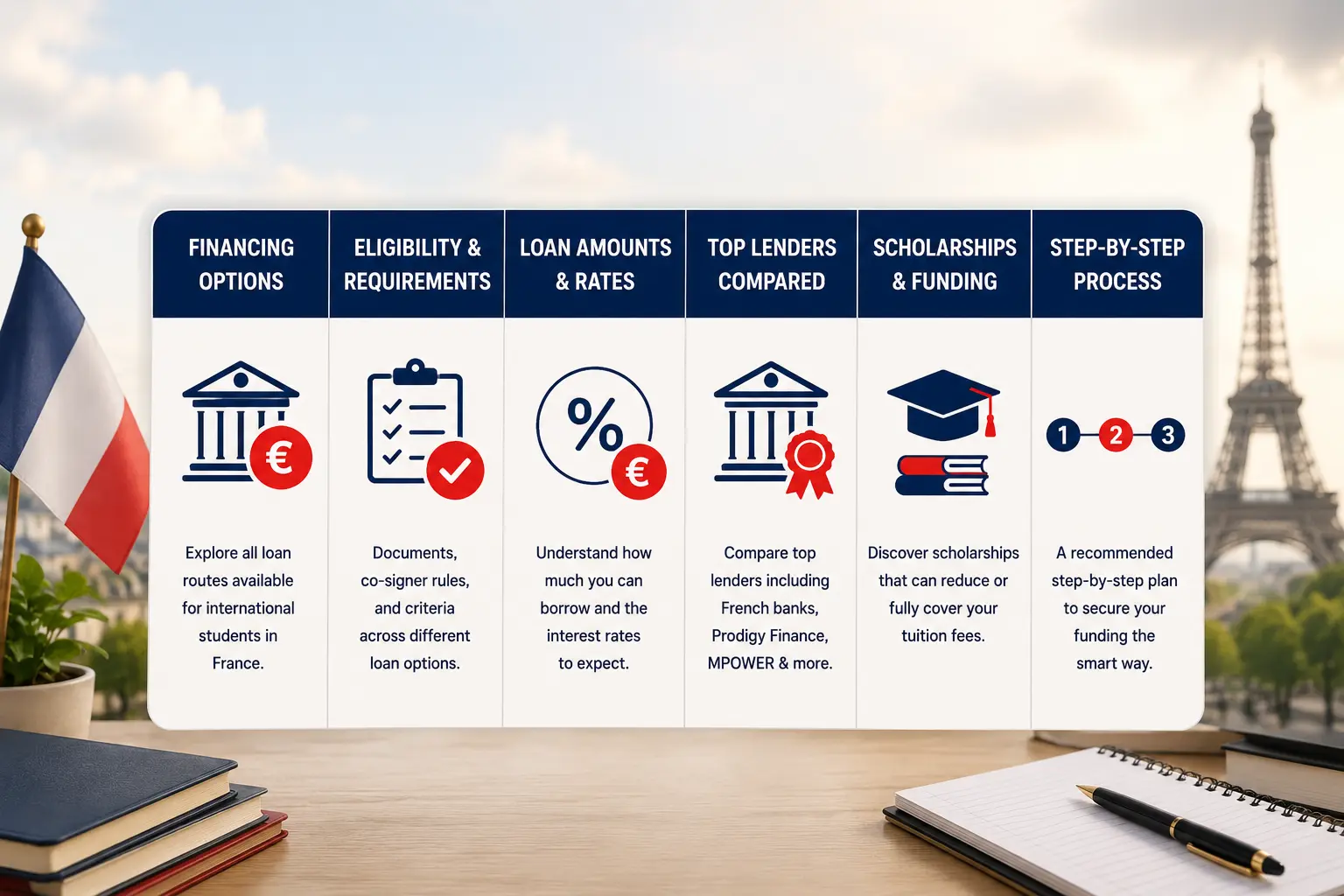
How to Finance Your Studies in France: Education Loans for International Students
(French State Loans · International Lenders · Home-Country Banks · No-Guarantor Options · Loan vs Scholarship, the 2026 Guide)
| French State-Guaranteed Loan (Max) |
BPI France Guarantee |
Prodigy Finance (Max) |
Repayment Deferral (Most Lenders) |
| €20,000 |
70% of loan value |
Up to $220,000 USD |
6–24 months post-graduation |
* All loan products are subject to individual eligibility. Rates and limits are current as of June 2026. Always verify directly with the lender before applying.
France is one of the most affordable study destinations in the world but 'affordable' is relative. Even at the new 2026 non-EU public university fees of €2,895 per year for a Bachelor's, add housing (€400–€900/month), food, transport, and insurance, and the annual cost of studying in France reaches €12,000–€20,000 for most students outside of Paris and significantly more in the capital. For most international students, some form of external financing is part of the plan.
The good news: the options are broader and more accessible than most students realise and France in particular has a government-backed loan scheme that removes the biggest single barrier: needing a guarantor. This guide covers every loan route available to international students in 2026, what each one costs, what it requires, and how to use a loan strategically alongside a scholarship to minimise the debt you graduate with.
1. Your Loan Options at a Glance
There are six main financing routes available to international students studying in France in 2026. Each has a different profile, in terms of amount, interest rate, guarantor requirements, and who it is realistically available to.
| Loan Route |
Best For |
Max Amount |
Interest Rate (2026) |
Guarantor Needed? |
French State-Guaranteed Loan
(via BPI France + partner banks) |
Students already in or enrolled at a French institution |
€20,000 |
≤ 1.5% (some partners offer 0.99%) |
No — state guarantees up to 70% of the loan |
French Bank Student Loan
(BNP, SG, BRED, CIC, etc.) |
Students with a French resident guarantor |
€20,000–€60,000 |
1.75%–3.5% typical |
Yes — French resident guarantor required |
| Prodigy Finance |
Postgraduate students at supported top-ranked institutions |
Up to $220,000 USD |
From ~9.66% variable (APR ~11.92%) |
No co-signer or collateral required |
| MPOWER Financing |
Graduate students and selected undergraduate programmes |
Up to $50,000 USD |
~12.99%–14.99% fixed (APR ~13.98%–16.04%) |
No — based on future earning potential |
| Erasmus+ Master Loan |
Master's students studying in another EU country |
€12,000 (1 year)
€18,000 (2 years) |
Low rate set by participating banks |
No — programme-backed |
Home-Country Bank Loan
(SBI, Axis, etc.) |
Students from countries with established study-abroad loan schemes |
Up to INR 3 Crore
(SBI Global Ed-Vantage) |
8.4%–10.45% (SBI)
9.25%+ (Axis) |
Parent/guardian co-applicant required; collateral may apply |
| University Partner Loans |
Students at participating Grandes Écoles and business schools |
Varies by institution (e.g. €60,000 at Audencia) |
As low as 0.99% (limited offers) |
Varies by programme |
* Interest rates, loan limits, and eligibility criteria vary by lender and applicant profile. Figures shown are indicative as of June 2026 and should be verified directly with the lender before applying.
2. The French State Guaranteed Loan: The Best Starting Point
The Prêt Etudiant Garanti par l'Etat (state guaranteed student loan) is France's flagship student financing scheme. The French government, through Bpifrance, guarantees 70% of the loan value, meaning partner banks take on far less risk, which is why they can lend without requiring a French guarantor or collateral from the student.
Who qualifies:
• You are enrolled in, or have a confirmed place at a recognised French higher education institution (university, Grande Ecole, or accredited private institution).
• You are under 28 years old at the time of application for most bank partners, though some extend to 35.
• You are a resident of France or a member state of the European Economic Area or you are an international student enrolled at a French institution (eligibility for non-EU students varies by partner bank; confirm directly).
• Your programme is at least one academic year in length.
Key terms:
• Maximum amount: €20,000, sufficient for most public university programmes; may need topping up for Grandes Ecoles or private institutions.
• Interest rate: Legally capped at a low level; most partner banks currently offer rates between 0.99% and 1.5% per annum, among the lowest student loan rates available anywhere.
• No guarantor required: The state provides the guarantee. You do not need a parent, relative, or French contact to back the loan.
• No collateral required: No property, no deposit, no security asset needed.
• Deferred repayment: Repayment begins 2 years after graduation, giving you time to find a job before your first payment is due.
• Repayment period: Typically 2–10 years after the deferral period ends.
• Partner banks: BNP Paribas, Société Générale, Crédit Agricole, CIC, BRED, and others, each with slightly different rates and terms.
How to apply:
• Visit etudiant.gouv.fr: the official French student portal and select 'Prêt étudiant garanti par l'Etat'.
• Check partner banks and apply through their branch or online portal. Different partners have different processing times allow 4–6 weeks.
• You will need your admission letter, passport, French address proof, and French bank account (RIB) for disbursement.
• Once approved, the loan is disbursed directly to your French bank account in tranches or as a lump sum depending on the bank.
Special Offer: Audencia Partner Bank Rate (May–September 2026)
Audencia Business School's banking partner is currently offering a state guaranteed student loan at 0.99% per annum with no application fees and no guarantor, valid for new applications made between 21 May and 30 September 2026. Similar time limited preferential rates appear regularly through university banking partnerships, always check whether your institution has a preferred bank partner before applying directly to a retail bank.
3. Standard French Bank Loans: If You Have a Guarantor
If you have a guarantor, a person with a French residence and stable income who agrees to repay the loan if you cannot, standard French bank student loans offer higher amounts and similar low rates without needing the state guarantee scheme. The guarantor is the key difference: with one, your borrowing capacity increases significantly.
| Bank |
Best For |
Maximum Loan |
Typical Rate |
Notable Features |
|
BNP Paribas
|
International and domestic students |
Up to €50,000 |
From ~2.5% |
Flexible repayment deferral options and strong international student support. |
|
Société Générale
|
Grande École and university students |
Up to €40,000 |
Competitive student rates |
Dedicated student banking package and tailored education financing. |
|
BRED Banque Populaire
|
Students at partner Grandes Écoles |
Varies by programme |
From ~1.75% |
Partner of several top schools including ESCP; preferential rates for eligible students. |
|
Crédit Agricole
|
Students across regional France |
Varies by region |
Region-specific rates |
Student packages often include banking, insurance, and additional discounts. |
|
CIC
/
Crédit Mutuel
|
Students in Lyon, Alsace, and regional cities |
Varies by profile |
Competitive student rates |
Well-known for student-friendly banking products and flexible financing options. |
* Loan amounts, interest rates, and eligibility requirements vary by profile, institution, and region. Always verify current terms directly with the bank before applying.
On the Guarantor Requirement
Most French banks require a guarantor who is a French resident with a permanent employment contract (CDI) and stable income, not just any French contact. A guarantor on a temporary contract or with significant existing debt may not be accepted. If you do not have such a person, the state guaranteed loan route (Section 2), Smarto, Prodigy Finance, or your home country bank (Section 5) are the right alternatives.
4. International Lenders: Borrow Without a Guarantor or Collateral
If you do not have a French guarantor and the €20,000 state guaranteed loan is insufficient for your programme costs, two international lenders specifically target international postgraduate students at top ranked institutions.
| Feature |
Prodigy Finance
|
MPOWER Financing
|
| Best For |
Postgraduate students at top-ranked international universities. |
Graduate students and selected undergraduate students without a guarantor. |
| Maximum Funding |
Up to $220,000 USD (programme-dependent). |
Up to $50,000 USD per academic year. |
| Interest Rate |
Variable; from ~9.66% (Representative APR ~11.92%). |
Fixed; ~12.99%–14.99% (APR ~13.98%–16.04%). |
| Co-signer / Guarantor |
Not required. |
Not required. |
| Collateral |
Not required. |
Not required. |
| Approval Basis |
Future earning potential, institution, programme, and career prospects. |
Future earning potential and academic profile. |
| Repayment Start |
6 months after graduation. |
6 months after graduation. |
| Repayment Term |
7, 10, or 20 years. |
10 years. |
| Fees |
4% administration fee added to loan principal + $500 processing fee. |
6.5% origination fee. |
| Early Repayment |
No prepayment penalty. |
Generally permitted; verify current lender terms. |
| French Institutions Supported |
HEC Paris, INSEAD, Sciences Po, ESSEC, CentraleSupélec and other eligible institutions. |
Selected French and European programmes only. |
| Additional Benefits |
Higher funding limits and broad coverage of elite international programmes. |
Visa support letter and free visa preparation resources. |
* Funding limits, interest rates, fees, and eligibility requirements vary by applicant profile and programme. Always verify current terms directly with Prodigy Finance or MPOWER Financing before applying.
A Note on Interest Rates for International Lenders
Prodigy Finance and MPOWER interest rates are significantly higher than French state guaranteed loans. This is the trade-off: they require no guarantor, no collateral, and no French administrative connection. If you qualify for the state guaranteed loan at 0.99%–1.5%, use it first and supplement with an international lender only for the shortfall. Never borrow more than you need at 10%+ rates when a lower-rate option exists.
5. Home Country Bank Loans: Often the Best Rate You Will Find
For students from countries with well developed student loan infrastructure particularly India, but also Morocco, Senegal, Côte d'Ivoire, and other countries with national development bank schemes, borrowing from a home country bank before departure is often the most cost-effective route available. The rates are typically lower than international lenders, the process is in a language you know, and the co-applicant (usually a parent or guardian) is someone already in your life.
For students from India:
• SBI Global Ed-Vantage Scheme: Up to INR 3 Crore (approximately €34,000 at current rates) for studies abroad including France; interest from 8.4% per annum; 15-year repayment tenure; collateral required for amounts above INR 7.5 Lakh. Approval in approximately 14–16 working days. France is on the eligible country list.
• Axis Bank International Education Loan: Interest from 9.25% per annum; both secured and unsecured options; up to INR 75 Lakh secured; online application available.
• HDFC Credila: Specialises in education loans for study abroad with flexible repayment; no collateral for smaller amounts; disburses directly to institution or student.
• Tax benefit: Under Section 80E of the Indian Income Tax Act, interest paid on education loans is fully deductible for up to 8 years, a meaningful advantage not available on French or international lender loans.
For students from Africa and other regions:
• Morocco: Banque Populaire and Crédit du Maroc both offer student loans for studies abroad. Check their étudiant expatrié products directly.
• Sub-Saharan Africa: Options are more limited through domestic banks. Prodigy Finance, the French state-guaranteed loan (if enrolled), or a combination of family support and scholarship is the most common model for West and East African students.
• Erasmus+ Student Loan Guarantee: Available to Master's students studying in a different EU country than their home country. Borrow up to €12,000 for a one-year Master's or €18,000 for two years through participating banks. Rates are low and the programme is EU-backed. Contact your local Campus France office to find participating banks in your country.
6. Getting Approved Without a French Guarantor
The absence of a French guarantor is the single biggest barrier most international students face when approaching French banks. Here are the routes that sidestep it entirely:
• State guaranteed loan (BPI France): As covered in Section 2, the state takes the guarantor role. No personal guarantor needed. Apply via etudiant.gouv.fr.
• Smarto: A French fintech that acts as a commercial guarantor for student loans. You pay a guarantee fee once funds are received; Smarto partners with French banks and enables borrowing without a personal guarantor. Fully online process. smarto.fr.
• University banking partnerships: Many Grandes Ecoles and business schools (HEC, ESCP, ESSEC, Audencia, ICN) have negotiated loan agreements with specific banks that waive or reduce guarantor requirements for their enrolled students. Check with your institution's student finance office before approaching any bank independently.
• International lenders (Prodigy, MPOWER): As covered in Section 4, no guarantor, no collateral.
• Home country loan: Your parent or guardian acts as co-applicant in your home country, this is not a French guarantor, and the process is entirely outside the French system.
| Document |
French Loan / BPI |
Prodigy Finance / MPOWER |
Home-Country Bank Loan |
| Valid Passport |
✓ Required |
✓ Required |
✓ Required |
| University Admission / Enrollment Letter |
✓ Required |
✓ Required |
✓ Required |
| Programme Fee Structure / Cost Breakdown |
✓ Required |
✓ Required |
✓ Required |
| Academic Transcripts (Last 2 Years) |
Helpful |
✓ Required |
✓ Required |
| Co-applicant / Guarantor ID & Income Proof |
Required if no state guarantee |
✗ Not Required |
✓ Required (Parent/Guardian) |
| Proof of French Address (Justificatif de Domicile) |
✓ Required |
✗ Not Required |
✗ Not Required |
| Bank Statements (3–6 Months) |
Sometimes Requested |
✗ Not Required |
✓ Required |
| French RIB (Bank Account Details) |
✓ Required for Disbursement |
✗ Funds Sent Directly to Institution |
✗ Funds Sent to You or Institution |
| Visa / Residence Permit |
Required if Already in France |
✗ Not Required at Application Stage |
Applied for Before Departure |
| Collateral / Property Documents |
✗ Not Required (BPI Route) |
✗ Not Required |
✓ Often Required Above ~INR 7.5 Lakh |
* Requirements vary by lender, programme, loan amount, and applicant profile. Preparing these documents before applying can significantly speed up approval and disbursement timelines.
7. Loan vs Scholarship: How to Combine Both Strategically
A loan and a scholarship are not mutually exclusive, in fact, the most financially efficient approach for most international students is to use both. The logic is simple: a scholarship reduces or eliminates your largest single expense (tuition), which means your loan covers only the smaller remaining costs (housing, food, travel) and a smaller loan means less debt and lower interest over time.
| Factor |
Loan |
Scholarship |
Combined Strategy |
| Repayment Required |
Yes — full amount plus interest must be repaid. |
No — funding does not need to be repaid. |
Scholarship covers tuition while the loan covers living costs, reducing overall debt. |
| Coverage |
Typically covers tuition, living expenses, travel, and setup costs. |
Usually covers tuition fees, stipend, or selected expenses. |
Can provide full study-cost coverage with minimal borrowing. |
| Application Timing |
Generally 3–6 months before programme start. |
Usually 6–12 months before programme start. |
Apply for scholarships first, then use a loan as a backup or top-up. |
| Impact on Visa Finances |
Loan approval letters can be used as proof of funds. |
Scholarship award letters are accepted as financial proof. |
Using both strengthens the financial section of a student visa application. |
| Best Use |
Accommodation deposits, flights, living expenses, and first-month setup costs. |
Tuition fees, often the largest single study expense. |
Scholarship pays tuition; loan covers housing and day-to-day expenses. |
| Tax Considerations |
Interest payments may be tax-deductible in some countries. |
Generally not considered taxable income. |
Maximising scholarship funding first can reduce taxable and repayable obligations. |
* For most international students, the strongest financial strategy is to secure scholarships first and use education loans only to cover any remaining tuition or living expenses.
The Recommended Order of Operations
| Step |
Action |
When |
Why It Matters |
|
1
|
Apply for Scholarships
|
6–12 months before programme start
|
Apply for every scholarship you qualify for, including the Eiffel Excellence Scholarship, Campus France scholarships, university merit awards, and bilateral government scholarships.
|
|
2
|
Calculate Your Funding Gap
|
After scholarship decisions
|
Determine exactly how much funding remains after scholarships are awarded, whether fully funded, partially funded, or unsuccessful.
|
|
3
|
Apply for Student Loans
|
Once funding gap is known
|
Start with the French state-guaranteed loan (lowest rates and no guarantor). If your funding gap exceeds €20,000, consider a home-country education loan or Prodigy Finance as a top-up.
|
|
4
|
Apply for CAF Housing Aid
|
Immediately after arrival in France
|
Submit your CAF application as soon as you have a signed lease. Housing support of up to €250/month can significantly reduce living costs and future borrowing needs.
|
Recommended strategy: Scholarships first → Calculate remaining costs → Lowest-cost loan options → CAF housing aid. This sequence minimizes debt while maximizing available financial support.
Final Thoughts
Financing your studies in France in 2026 requires matching the right loan to your specific situation, your institution, your nationality, whether you have a French guarantor, and how much your scholarship already covers. The French state-guaranteed loan is the best starting point for almost everyone: low rate, no guarantor, and available through multiple partner banks. Beyond that, Prodigy Finance fills the gap for postgraduate students at top institutions, home country banks are often the cheapest route for students from India and North Africa, and the Erasmus+ loan is an underused option for EU-programme Master's students.
Apply early, most loan processes take 4–8 weeks from application to disbursement, and you will need confirmation of funding before your visa appointment. And always apply for scholarships before loans. Every euro you don't borrow is a euro you don't pay interest on.
Need Help Navigating Your Financing Options?
Choosing the right loan or the right combination of loans and scholarships is one of the most important financial decisions you will make before arriving in France.
Dimensions France advisors have helped hundreds of students across Africa, Asia, and beyond build financing plans tailored to their institution, academic profile, budget, and long-term career goals.
Contact Dimensions France
Dimensions France
www.dimensionsfrance.com
contact@dimensionsfrance.com