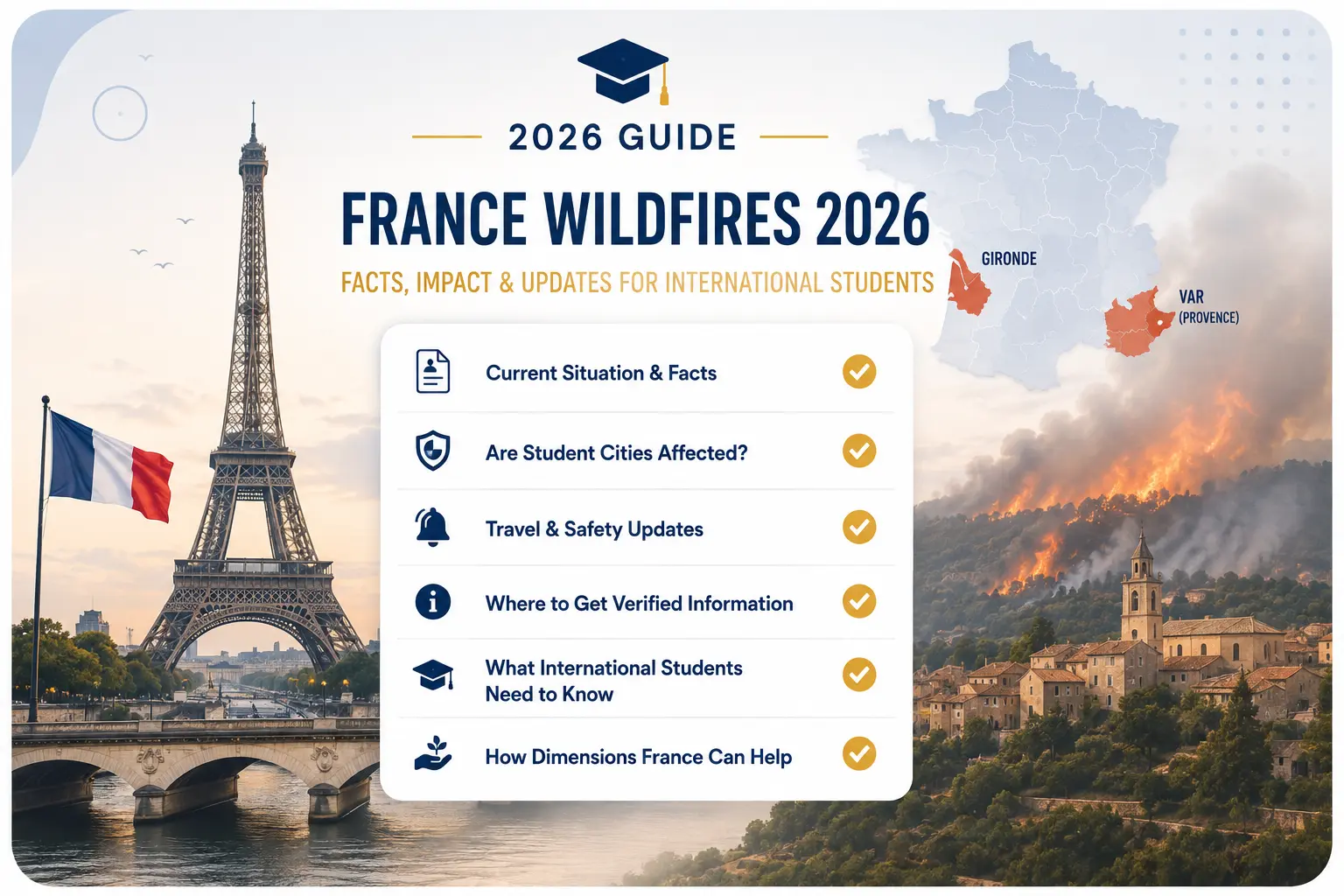
France Wildfires 2026: What International Students and Families Need to Know
(The Facts on Gironde and Provence, Why Your University City Isn't Affected, and How to Stay Properly Informed)
| Hectares Burned (2026, National) |
vs 20-Year Average |
Major Fire Zones |
Student Cities Directly Affected |
| 90,000+ hectares |
More than 500% above the 20-year average. |
Gironde & Var (Provence) |
0 major student cities directly affected. |
If you've searched "France wildfires 2026" after seeing news coverage, you're not overreacting, it has been a genuinely serious summer for parts of rural and coastal France. Two major wildfires, near Bordeaux and in inland Provence, have burned tens of thousands of hectares between them and forced large scale evacuations. If you or your family are due to start a French university programme this September, or if you're already here, this guide gives you the verified facts, without the panic and without downplaying what's real.
1. What's Actually Happening This Summer
France recorded its hottest June since national records began in 1947, and a prolonged summer drought has driven one of the country's most severe wildfire seasons in decades. Two fire clusters have dominated the news:
The Gironde wildfire, southwest of Bordeaux: Breaking out in late July, this fire burned roughly 42,000 hectares over about nine days, mostly across forested and coastal land in the Gironde and Landes departments, west of Bordeaux around Le Porge and the Lège-Cap-Ferret peninsula. At its peak, evacuation orders covered up to 250,000 people, almost entirely from Atlantic coastal towns and campsites, not from the city of Bordeaux itself. Two firefighters lost their lives battling the blaze near Bordeaux–Mérignac airport, and officials have confirmed no civilian deaths. France's interior minister announced the fire was contained on 1 August, meaning it has stopped spreading, and most evacuees have already returned home.
The Var wildfire, inland Provence: Centred on the Gros Bessillon massif near the villages of Correns, Cotignac, and Barjols, this fire first broke out on 19 July and has reignited several times since, most recently over the weekend of 31 July to 2 August. Around 1,300 to 1,500 firefighters and multiple water bombing aircraft have been deployed, with 2,500 to 4,000 residents evacuated at various points as flare ups moved through the area. As of the Var prefecture's latest update, the situation is described as active but stable.
A smaller fire also burned through the Fontainebleau forest, roughly 60 km south of Paris, in mid-July, the only 2026 blaze to come close to a major student city. It was brought under control within days and never reached Paris itself.
Nationally, more than 90,000 hectares have burned across France so far in 2026, over five times the 20 year average, and the interior ministry has described the country as fighting 30 to 40 wildfires a day at the peak of summer.
Dimensions France Tip: Distinguish the Headline from the Location
News coverage understandably focuses on the most dramatic images and those images are almost always from the two active fire zones, not from the cities where students actually live. Before reacting to a headline, check exactly which department or town is affected.
2. Why This Doesn't Affect Term Start or Your University City
If you're due to start a programme in France this September, here's the direct answer: None of France's major university cities have experienced direct wildfire damage or large scale disruption to university operations.
1. Paris: unaffected. The nearest fire (Fontainebleau) was contained in mid-July roughly 60 km away, and air quality in the capital was not significantly impacted.
2. Lyon, Toulouse, Lille, Strasbourg, Grenoble: all several hundred kilometres from both the Var and Gironde fire zones, with no wildfire activity reported near any of them.
3. Bordeaux: the city itself was not evacuated or burned. The Gironde fire burned rural, forested land 40 to 60 km west of the city along the Atlantic coast. Smoke haze was visible in Bordeaux on the worst days in late July, but daily life, transport, and university operations continued largely as normal
France's 2026 wildfire season is a genuinely serious event for the rural and coastal communities it has hit directly, and, for daily life in the cities where international students live and study, it has had close to no impact at all.
3. The Bigger Climate Picture
This isn't an isolated event. Scientists at World Weather Attribution have linked this summer's extreme heat and drought directly to climate change, and France's wildfire season, roughly June to September, has become a predictable, recurring feature of the French summer, especially across the south. Understanding that pattern is more useful than reacting to any single week's headlines: the risk is real, it's regional, and it's seasonal, not a reason to reconsider studying in France.
4. If You're Travelling South This Summer
Most students reading this will never be near an active fire zone. But if your plans include Provence, the Var, Corsica, or the Atlantic coast before term starts, a few checks take minutes and matter:
• Check the Météo-France vigilance map before travelling to any southern or coastal region during fire season.
• Follow the relevant préfecture's website or social accounts for evacuation orders or road closures, these override any personal travel plan immediately.
• Avoid forested areas and hiking trails under orange or red fire risk alerts, even if they look fine on the day.
• Know your accommodation's evacuation plan if you're staying in an affected region, and keep your phone charged.
• Book refundable transport and accommodation for peak-season trips to high risk areas, so a change in conditions doesn't cost you money on top of disruption.
• Be aware of local air quality. Even outside active fire zones, changing wind conditions can carry smoke over nearby towns and cities. If you have asthma, allergies, or another respiratory condition, check local air quality updates before spending extended periods outdoors. On days when smoke levels are elevated, keeping windows closed where possible, limiting strenuous outdoor activity, and following advice from local authorities can help reduce exposure.
5. Travel Insurance and Registering with Your Embassy
Most student travel and health insurance policies cover emergency evacuation, but check your policy explicitly for a natural catastrophe or disaster clause before you need it, not after. It's also worth registering with your home country's travel advisory or embassy service once you arrive in France. This matters more for a study move than a short holiday: you're committing to months in the country, and your embassy needs an accurate record of where you are if a future situation requires it.
6. What Dimensions France Is Doing
We're monitoring official government and Météo-France guidance daily throughout the fire season. If anything changes that could affect visa appointments, travel plans, or the start of term for our students, we will contact enrolled and incoming students directly by email rather than leaving anyone to piece it together from the news.
Dimensions France Tip: If You're Anxious, Ask Us Directly
If you or your family are worried after seeing coverage of this summer's fires, don't rely on scrolling for reassurance. Email us directly and we'll give you a straight answer about your specific city, programme, and travel dates.
Quick Reference
Where to Get Verified Information About the France Wildfires
| Resource |
What It's For |
Where |
| Météo-France Vigilance |
Daily wildfire risk, weather warnings, and departmental alerts. |
vigilance.meteofrance.fr |
| Local Préfecture Website or Social Media |
Official evacuation orders, road closures, and emergency updates. |
Search for "[Department Name] Préfecture" (e.g. Préfecture du Var). |
| France 24 & Le Monde |
Live English and French news coverage of ongoing events. |
france24.com
lemonde.fr/en
|
| Your Embassy's Travel Advisory |
Official travel guidance and safety advisories for your nationality. |
Visit your home country's Ministry of Foreign Affairs or Embassy website. |
| Dimensions France |
Support for enrolled and incoming students regarding accommodation, travel, and university guidance. |
contact@dimensionsfrance.com |
Final Thoughts
It's reasonable to feel unsettled seeing wildfire footage from a country you're about to move to. The honest picture is this: 2026 has been a hard summer for parts of rural Provence and the Atlantic coast, and a largely unremarkable one for the cities where French university life actually happens. Paris, Lyon, Toulouse, Bordeaux, Lille, Strasbourg, and Grenoble are all open, operating normally, and preparing for the September intake as planned. Check the sources above if you want to follow the situation yourself, and reach out to us directly if you want a straight answer about your own plans.
Questions About Your Move to France?
Planning your move to France can feel overwhelming, but you don't have to do it alone. Dimensions France supports international students from the moment they choose France until they are fully settled into their new life. Whether you need help with your student visa, accommodation, arrival preparations, or understanding French administrative procedures, our team is here to guide you every step of the way. We also keep students informed about important travel updates and developments that could affect their journey or the start of their studies.
Trusted by students from 25+ countries for personalised support before departure, on arrival, and throughout their first months in France.
Contact Dimensions France
Also Read:
France Student Visa 2026 |
Accommodation in France |
CAF & ANEF Guide |
Cost of Living in France