What Is Student Life Really Like in France?
(From People Who've Lived It : Sociial Life, Nightlife, Dating, Mental Health & Every Discount You Should Be Using)
| International Students (2024–25) |
% of All Students in France |
Cities with 50,000+ Students |
Potential Student Discounts per Year |
| 430,000+ |
~14% |
10+ |
Up to €1,500 |
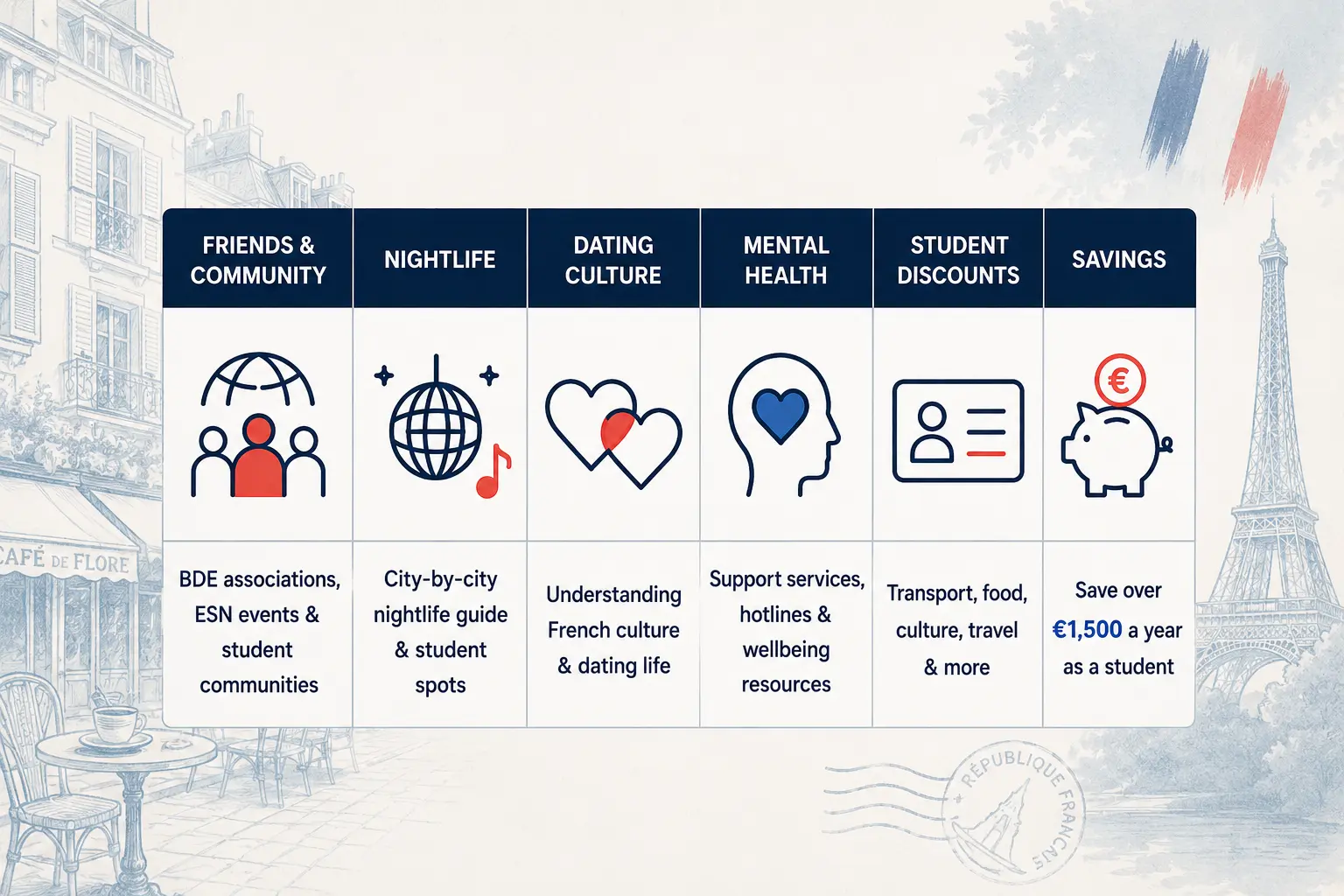
There is a version of student life in France that exists in brochures, a beautiful city, famous food, and excellent universities. And then there is the real version: the week you realise you have no idea how to make friends in a country where people don't talk to strangers on the metro; the admin day that eats your entire Tuesday; the moment, usually sometime in month two, when something clicks and you realise you are actually building a life here.
This guide is for that real version. It covers the social dynamics honestly, tells you how French student culture actually works, and gives you the practical knowledge, from city nightlife to mental health resources to every discount worth activating that most guides leave out. France welcomed a record 430,000 international students in 2024–25. Here is what they learned.
1. Making Friends as a Foreigner & What Actually Works
The most consistent thing international students say about their first weeks in France is some version of: 'It was harder than I expected, and then better than I imagined.' France is not an immediately warm country in the Anglo-Saxon sense. French people don't strike up conversations with strangers easily. They don't ask where you're from in a lift. Friendships here form more slowly but when they do, they tend to last.
The students who integrate fastest are the ones who understand this early and stop waiting to be invited in. Social life in France almost never comes to you. You go to it.
What works:
• Show up to Welcome Week (Semaine d'intégration) on day one: Every university and Grande Ecole runs an orientation period. It feels awkward for everyone, which means everyone is equally open. The friendships made in the first week disproportionately define the year.
• Join at least two associations (BDEs, BDAs, or clubs) in the first fortnight: Not because you'll love every event, but because repeated exposure to the same faces is how friendships form. Shared activity: a sports team, a debate club, a cooking association is the fastest route past the French reserve.
• Speak whatever French you have, immediately: Students consistently report that making an effort even imperfect, even embarrassing, is the single most effective social signal you can send. French people respond warmly to the attempt, even when the result is chaotic.
• Find your ESN chapter: The Erasmus Student Network (ESN) operates across every major French university city. ESN events are explicitly designed for international students and mix nationalities deliberately. If you need a social life fast in the first two weeks, this is your most reliable starting point.
• Move beyond the international bubble but don't feel guilty about it: Having a core group of international students is normal and fine, especially early on. The problem is when it becomes the only circle. Push yourself toward one or two French majority associations,the payoff for your language, your cultural understanding, and your long term network is significant.
• Propose the coffee: French students don't organise spontaneous group outings the way some other student cultures do. If you want to get closer to someone from your class, you have to suggest it yourself. A direct 'on prend un café?' After a lecture is more socially effective in France than waiting for a group invitation that may never come.
Dimensions France Tip: The First Month Rule
Students who join at least two associations in their first month integrate significantly faster than those who don't and are more likely to find internships, form lasting networks, and feel settled by the end of semester one. Treat the first month like a social sprint. You can slow down in month three once you have a circle. You cannot recover a missed first month the same way.
2. Student Associations and BDE Culture: The Heart of Social Life
If there is one thing that defines French student social life above everything else, it is the association. Every French university and Grande Ecole has dozens, sometimes hundreds of student-run organisations covering sport, culture, humanitarian work, entrepreneurship, music, debate, food, language exchange, and more. At the top of the structure sits the BDE (Bureau des Étudiants) , the main student union equivalent, which organises large-scale events, integration weeks, and the famous soirées étudiantes (student parties).
At Grandes Ecoles like HEC, Sciences Po, and ESSEC, the association culture is especially intense. Student associations at these schools organise ski trips, international forums, consulting competitions, gala dinners, and music festivals, often with professional-level production. At public universities, the scale is more varied, but the breadth of associations is often even wider.
Associations worth knowing about:
• BDE (Bureau des Étudiants): your main student life hub. Organises integration events, soirées, and manages student services. Always the first association to find.
• BDA (Bureau des Arts): arts and culture association. Theatre, music, film, exhibitions. Strong at most universities and arts-oriented Grandes Ecoles.
• BDS (Bureau des Sports): runs inter-university sport competitions and recreational sports. Free or very low cost for enrolled students.
• ESN (Erasmus Student Network): specifically for international and exchange students. Organises city tours, day trips, language exchanges, and social events in every major student city.
• Humanitarian and volunteer associations: Enactus, AIESEC, associations fighting food poverty (like Les Restos du Cœur volunteer branches). Taking part is both meaningful and a strong CV entry.
• International and cultural associations: most universities have country specific and region specific associations: African student associations, Asian student networks, South Asian communities. These provide a community anchor, especially early on.
• Entrepreneurship and business clubs: Junior Enterprises (Juniors Entreprises) at most Grandes Ecoles run real consulting projects for paying clients. Joining is one of the best ways to build professional skills and network simultaneously.
How to Find Associations at Your Institution
Every university publishes its association directory online, search 'associations étudiantes + [your university name]'. The first week of each semester, associations set up stalls in the main hall or campus square for a 'forum des associations' the equivalent of a freshers' fair. Go to every stall, even briefly. You can always drop an association that doesn't fit; you can't join one you never heard about.
3. Nightlife and Culture by City: Where to Go and What to Expect
France's student nightlife varies enormously by city in price, vibe, culture, and how students actually socialise after dark. One thing that surprises almost every international student: French nights start late. Dinner at 8 PM, apéro until 10 PM, going out at midnight is completely normal. Don't arrive at a club at 10 PM expecting a crowd, you will be alone with the DJ.
| City |
Student Nightlife Vibe |
Key Areas & Spots |
Average Drink Cost |
Insider Note |
| Paris |
Sophisticated and diverse; everything from jazz bars to underground techno. |
Oberkampf, Pigalle, Montmartre, Canal Saint-Martin, Rex Club. |
Beer: €7–9
Cocktail: €12–15 |
Pre-drinks (pré-soirée) at someone's flat are a Paris tradition. Most clubs do not fill before 1 AM. |
| Lyon |
One of France's most social student cities with affordable nightlife. |
Rue Sainte-Catherine, Croix-Rousse, Presqu'île, Vieux Lyon. |
Beer: €4–6
Cocktail: €8–10 |
Frequently ranked among France's best student cities. Easier to build friendships than in Paris. |
| Toulouse |
The famous "Ville Rose" with an energetic student atmosphere. |
Place Saint-Pierre, Rue Gabriel Péri, Le Bikini, Canal du Midi. |
Beer: €4–5
Cocktail: €7–9 |
Chez Tonton at Place Saint-Pierre is a legendary student meeting point and local institution. |
| Bordeaux |
Wine culture by day, lively bars and clubs by night. |
Quai du Paludate, Chartrons, Rue Parlement-Saint-Pierre. |
Wine: €5–7
Cocktail: €8–11 |
Nightlife starts late. Clubs often open around midnight and continue until dawn. |
| Grenoble |
Compact, friendly city with strong outdoor and mountain culture. |
Place Saint-André, Rue Jean-Jacques Rousseau, Granges terraces. |
Beer: €4–5
Cocktail: €7–9 |
Ski clubs are central to student life. Many weekends revolve around mountain trips. |
| Lille |
Underrated nightlife with a welcoming student community. |
Vieux-Lille, Rue de Gand, Solférino, La Malterie. |
Beer: €3–5
Cocktail: €7–8 |
Among the cheapest nightlife scenes in France. Weekend trips to Belgium are common. |
Beyond nightlife, France's cultural offer for students is extraordinary and almost entirely free or subsidised. National museums (Louvre, Musée d'Orsay, Centre Pompidou, Versailles) are free for all under-26 non-EU students to their permanent collections. The Fête de la Musique on 21 June is a nationwide free live music festival every street, every city, every genre, all night. Local marchés (markets) are free, social, and the most authentic way to spend a Saturday morning in any French city.
The Apéro: France's Most Important Social Ritual
Before any dinner, before any party, there is the apéro, short for apéritif. It's drinks, small snacks (olives, cheese, charcuterie), conversation, and no fixed end time. At someone's flat, in a café, or on a terrace. It is how French students actually catch up and connect. Being invited to someone's apéro is a significant social signal, it means you have moved from acquaintance to friend. Hosting one yourself is the fastest way to deepen your social circle. A bottle of wine and some cheese from Lidl costs less than one drink in a club.
4. Dating Culture and Social Norms in France
French dating culture is one of the most misunderstood aspects of student life for international arrivals, partly because it operates on different rules to nearly every other country, and partly because French people rarely explain those rules out loud. Here is what actually applies:
There is no word for 'dating' in French.
The closest equivalent is sortir ensemble, 'going out together.' This reflects something real: in France, there is no defined stage of 'dating' that precedes being in a relationship. Things tend to move quickly from acquaintance to couple without the structured sequence of first date, second date, defining the relationship that exists in many Anglo-Saxon cultures. This can feel fast or ambiguous if you're not used to it.
| Topic |
What to Expect in France |
Advice for International Students |
| Meeting People |
Relationships often begin through shared social circles, university life, cafés, parties, and mutual friends rather than dating apps alone. |
Focus on building a social network first. Apps can help, but real-world interactions remain the most effective way to meet people. |
| Dating Apps |
Happn is especially popular in Paris, while Bumble is growing in Lyon, Bordeaux, and Toulouse. Meetic remains one of France's largest dating platforms. |
Use apps as a supplement to your social life rather than your primary strategy for meeting people. |
| French Flirting Style |
Flirting tends to be subtle, conversation-driven, and intellectual rather than overly direct or performative. |
Pay attention to engaged conversations, eye contact, and genuine interest rather than expecting obvious signals. |
| Dating Expectations |
There are few formal dating rules. Concepts such as "waiting three days to text" are generally uncommon. |
If you like someone, expressing interest naturally and honestly is usually appreciated. |
| Public Displays of Affection |
Holding hands, kissing, and affectionate behaviour in public are widely accepted. |
Moderate affection is normal. Excessive or attention-seeking displays are generally viewed less positively. |
| Diversity & Relationships |
Mixed-nationality and interracial relationships are common in major student cities such as Paris, Lyon, Bordeaux, and Toulouse. |
International students are unlikely to encounter issues related to diversity in most large university cities. |
| International Student Experience |
Many students initially build friendships and relationships within international communities. |
Do not feel pressured to immediately understand every aspect of French dating culture. Strong friendships often lead to wider social opportunities naturally. |
On Maintaining Identity While Adapting
One thing many students don't expect: France can make you feel both very free and occasionally very foreign. The country is secular, socially liberal, and largely non-judgmental about personal choices in the cities. At the same time, if your cultural background involves very different expectations around gender roles, relationships, or social interaction, the adjustment can feel significant. Both things can be true: France is genuinely welcoming, and the adaptation takes real effort. Give yourself time, and find your community.
5. Mental Health: What You Will Feel, and Where to Get Help
Talking about mental health as a student in France is still less normalised than in some countries, but the resources are better than most students realise, and the stigma is lower than it used to be. The most important thing to know is this: using mental health support in France does not affect your visa, your student status, or your academic record. Medical records are protected by privacy law and are never shared with immigration authorities.
What students commonly experience:
• The arrival dip (weeks 2–6): the adrenaline of arrival fades, the reality of admin, language, and distance from home sets in. This is nearly universal and almost always temporary. Knowing it is coming makes it easier to manage.
• Language fatigue: processing lectures, conversations, and daily life in a second language is genuinely exhausting. Research confirms it costs 20–30% more cognitive energy than operating in your mother tongue. By Thursday, you may feel tired in a way that has nothing to do with your sleep. This is real, normal, and improves steadily over months.
• Homesickness that peaks around month 3: not month one, when everything is new. Month three, when the novelty has worn off and you're not yet fully settled. This is the most common point at which students consider leaving. Most who push through describe month four or five as when things genuinely turned.
• Financial stress: exchange rate pressure, unexpected costs, and the gap between what was planned and what France actually costs. This is one of the top reported stressors for students from countries with weaker currencies. If this is hitting you, speak to your university's social services (CROUS social workers offer emergency grants and emergency food access to enrolled students in genuine financial difficulty).
• The pressure to perform publicly: Many international students feel they must present a positive face to their family back home who sacrificed for them to be here, to their peers, to themselves. The gap between the performance and the reality is exhausting. Find at least one person you can be honest with.
Mental health resources available to you in France:
| Resource |
Who It's For |
How to Access |
Cost |
| Santé Psy Étudiant (Mon Soutien Psy) |
All students studying in France, regardless of nationality. |
Visit the official Santé Psy platform, find a partner psychologist, and book an appointment through Doctolib. |
Free: up to 12 sessions per year with referral requirements depending on the programme. |
| SUMPPS (University Preventive Health Service) |
Students enrolled at French universities. |
Contact your university's SUMPPS or student health office directly. |
Free: included through student services and the CVEC contribution. |
| Nightline Paris |
Students experiencing loneliness, stress, anxiety, or emotional difficulties. |
Access anonymous support via phone or online chat through Nightline. |
Completely free and confidential. |
| SOS Help (English Support) |
English-speaking students or anyone seeking emotional support. |
Telephone support available daily between 3 PM and 11 PM. |
Free support service in English. |
| Terrapsy |
People experiencing isolation, emotional distress, or psychological difficulties. |
Telephone support available Monday–Friday during business hours. |
Free service available in French, English, and Arabic. |
| Student Mutuelle (Health Top-Up Insurance) |
All enrolled students seeking additional healthcare coverage. |
Available during enrolment or through providers such as LMDE and SMENO. |
Typically €100–250 per year depending on coverage level. |
Practical Habits That Actually Help
Move your body at least three times a week, SUAPS university sport is free and available to all enrolled students across 50+ sports. Exercise is consistently the highest-impact low-cost mental health intervention available.
Keep one video call per week with someone from home who will hear you honestly, not a performance call, a real one.
Build a routine around food. CROUS Resto'U meals for €3.30 are not just a budget tool, having a regular lunch spot with familiar faces builds the kind of daily structure that is protective against isolation. If you notice you haven't left your flat for two consecutive days, that is your signal. Go to a café, a library, a market, anywhere with people.
6. Student Discounts and Perks: What You Should Be Using in 2026
A well-informed student in France can realistically save over €1,500 a year through discounts alone, on top of the subsidised education and CAF housing aid that most international students already know about. The discounts that move the needle most are on recurring, high-cost items: transport, food, and software. The cultural discounts are a bonus on top of that.
| Category |
Discount / Benefit |
How to Access |
Estimated Annual Saving |
| Transport — Île-de-France |
Imagine R card: unlimited Paris metro, bus, tram, and RER travel for students under 26. |
Apply via
Île-de-France Mobilités
or at major metro stations with student proof.
|
~€400+ per year compared with a standard monthly Navigo pass. |
| Transport — SNCF Trains |
Carte Avantage Jeune offers 30–60% discounts on many intercity train journeys for travellers under 27. |
Available through
SNCF Connect.
|
Often pays for itself after one or two round trips. |
| National Museums & Monuments |
Free entry to permanent collections at many national museums and monuments for eligible students. |
Show your student ID and identification at participating venues. |
Potentially hundreds of euros annually for regular visitors. |
| Cinema |
Student tickets typically cost €5–7 instead of €12–14. |
Present your student card at cinemas such as Pathé, UGC, MK2, and CGR. |
~€50–100 per year for regular moviegoers. |
| Meals — CROUS Resto'U |
Full student meals from approximately €3.30 at university restaurants. |
Register through
CROUS
and use your student card.
|
Up to €1,800+ annually compared with purchasing lunch daily at cafés. |
| Software — Microsoft 365 |
Word, Excel, PowerPoint, Teams, and other Microsoft services often included through university licences. |
Access through your university ENT (Espace Numérique de Travail) or student portal. |
€100+ per year. |
| Software — Adobe Creative Cloud |
Student pricing with substantial discounts on Photoshop, Illustrator, Premiere Pro, and more. |
Verify student status via
Adobe Education.
|
~€500 per year compared with standard subscriptions. |
| ISIC Card |
Access to 150,000+ discounts worldwide across travel, museums, retail, and entertainment. |
Available from
ISIC France.
|
Often pays for itself after the first few uses. |
| Pass Culture |
Eligible young residents can receive cultural credit for books, events, concerts, and activities. |
Register at
Pass Culture.
|
Up to €300 in cultural spending credit. |
| Phone & SIM Plans |
Budget mobile plans from providers such as Free Mobile, RED by SFR, and Lebara. |
Available online or through local phone shops without long-term contracts. |
~€200–350 per year versus premium plans. |
Three Things Students Consistently Forget to Activate
1. The CROUS Resto'U. Students who don't register and use this regularly are spending €8–12 on lunch every day when they could spend €3.30. Over an academic year, that is a difference of over €1,500. Find your nearest Resto'U on the day you arrive.
2. Microsoft 365 via university licence. Almost every French public university and Grande Ecole has a campus agreement. Check your ENT (digital portal) in week one. Most students pay for Office when they don't need to.
3. Free museum entry. Students under 26 get free permanent collection access at every national museum in France. The Louvre alone charges €22 standard entry. Use it on a Sunday afternoon, it costs nothing and is one of the genuinely extraordinary perks of being a student here.
Final Thoughts
The students who have the best time in France are rarely the ones who arrived most prepared academically. They are the ones who showed up socially, who joined the association they weren't sure about, who invited someone for coffee before they felt confident in their French, who went to the Fête de la Musique alone and came back with three new friends.
Student life in France rewards initiative more than almost any other quality. The resources are there, the associations, the discounts, the mental health support, the cultural access. But they require you to reach for them. France will not come to you in the first month. Go to France. The second, third, and fourth months will be different.
Ready to Start Your Student Life in France?
Dimensions France supports international students from the moment they decide on France to the day they settle in and beyond.
From visa guidance and accommodation support to orientation, community building, and career advice, we have helped hundreds of students across Africa, Asia, and beyond build a successful life in France.
Contact Dimensions France
Dimensions France
www.dimensionsfrance.com
contact@dimensionsfrance.com