France's New Tuition Fees for Non-EU Students 2026–27: Who Pays, Who Is Exempt ?
What Decree No. 2026-385 Changes for International Students at French Public Universities
QUICK REFERENCE
€2,902
Annual differentiated tuition fee for eligible non-EU students pursuing a national Licence degree in 2026–27.
€3,950
Annual differentiated tuition fee for eligible non-EU students pursuing a national Master's degree in 2026–27.
30%
Maximum individual-exemption quota for the 2026–27 academic year, subject to the decree's rules and exclusions.
21 May
Decree No. 2026-385 entered into force on 21 May 2026.
Important: These differentiated fees do not apply to every international student. Eligibility for exemptions depends on the student's circumstances and the applicable rules. The 30% figure is an exemption quota for 2026–27, not a guarantee that an individual student will receive an exemption.
Non-EU students starting at a French public university in 2026–27 should expect to pay about €2,902 a year for a licence or €3,950 for a master, unless they qualify for an exemption. The fees themselves are not new, France introduced them in 2019. What changed is that a decree published on 20 May 2026 sharply limits how many students universities can exempt.
This guide covers who pays, who does not, how many exemptions universities can now grant, and how to ask for one. Every figure comes from the French ministry of higher education unless stated.
In short: Decree no. 2026-385 of 19 May 2026 has applied since 21 May 2026. Universities can exempt at most 30% of the non-EU students in the relevant category in 2026–27, 25% in 2027–28 and 20% from 2028. Doctoral students, scholarship holders and several other groups are not affected.
1. What changed in 2026?
Differentiated fees have existed since 2019, but the ministry says universities used broad exemptions so widely that the policy lost its purpose. The 2026 decree ends exemptions based on general or category wide reasons. A university can now exempt a student only because of their personal situation, especially their resources, and only within a cap.
The decree applies to public institutions under the higher education ministry. It does not set the fees of private business schools, so check those directly with the school.
2. 2026–27 fees at public universities
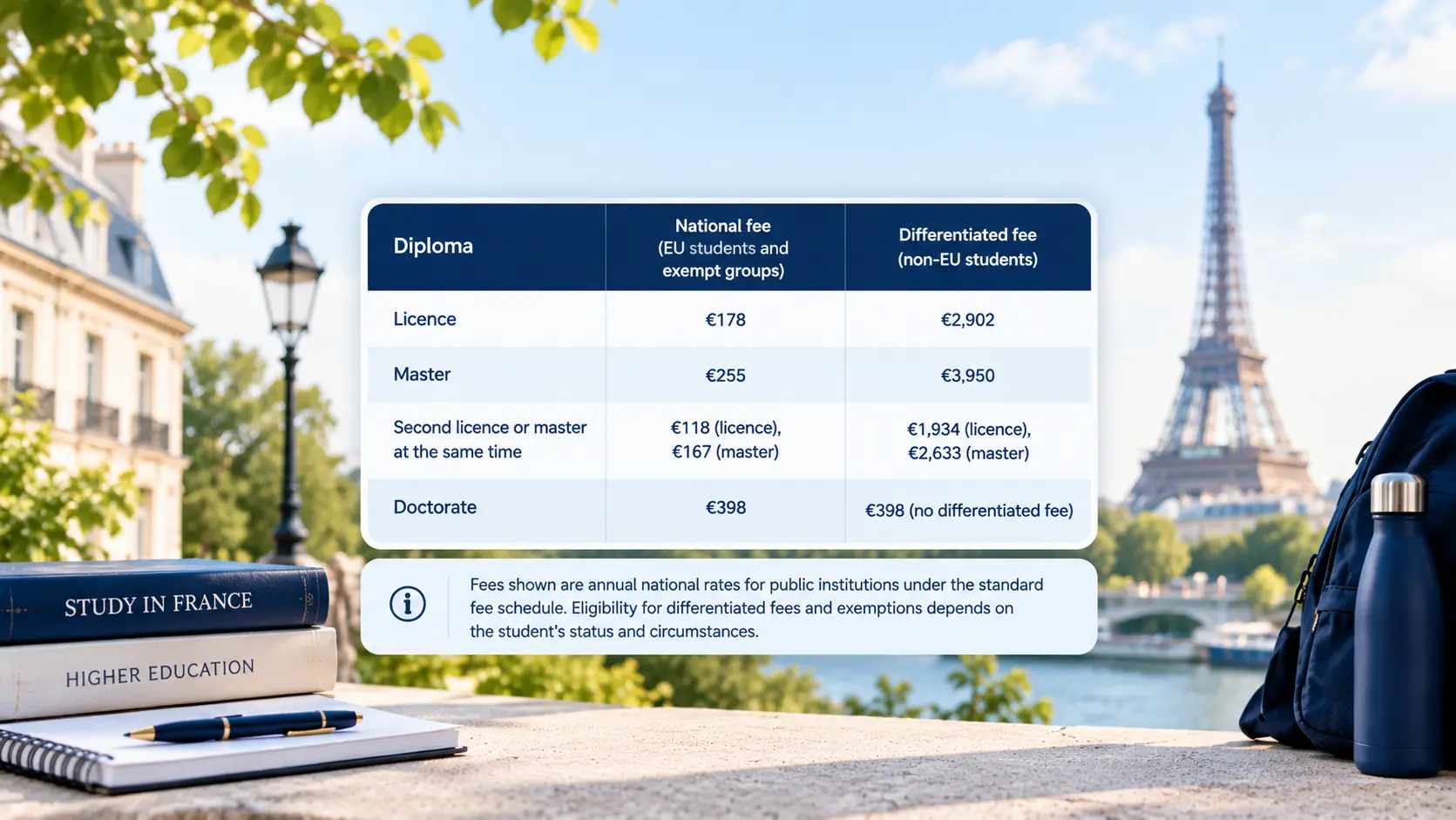
The ministry's fee schedule for 2026–27 sets these annual amounts for national diplomas.
Tuition Fees at a Glance
| Diploma |
National Fee
(EU students and exempt groups) |
Differentiated Fee
(non-EU students) |
| Licence |
€178 per year |
€2,902 per year |
| Master |
€255 per year |
€3,950 per year |
| Second Licence or Master at the Same Time |
Licence: €118
Master: €167
|
Licence: €1,934
Master: €2,633
|
| Doctorate |
€398 per year |
€398 per year
No differentiated fee
|
Important: These are annual registration fees for public universities. Differentiated fees do not apply to every non-EU student; exemptions and eligibility rules may apply. Confirm the applicable fees with the university for the relevant academic year.
The differentiated fee is roughly 16 times the national fee. Press coverage earlier in 2026 quoted €2,895 and €3,941, which were the 2025–26 amounts. The ministry indexes the fees to inflation each year.
Tip
Engineering degrees and other institution level diplomas ("diplômes d'établissement") have fees set by the institution's own board, so the differentiated fee does not apply to them. Ask the institution for its fee schedule.
3. Who pays the differentiated fee and who does not ?
The fee applies to international students in mobility who do not fall into any group below:
Pay the national fee (not subject to differentiated fees)
• French nationals and citizens of the EU, EEA, Switzerland, Monaco, Andorra and Québec
• Doctoral students and students preparing the habilitation (HDR)
• Refugees, people with subsidiary protection, and their children
• Long-term residents in France and their minor children
• People who have been tax-resident in France, or attached to a French tax household, for more than two years
• Students in preparatory classes (CPGE)
• Students on institution level diplomas, including engineering degrees
• Apprentices, since training is free for apprentices
Exempt automatically (and outside the cap)
• Holders of French state higher education scholarships, including social criteria bursaries and French government scholarships (BGF)
• Wards of the Nation
• Students covered by an exchange agreement between institutions that gives French students the same treatment abroad (reciprocity)
Erasmus Mundus students are handled differently: the consortium sets a project fee, and the scholarship covers it for grant holders.
4. How many exemptions universities can grant ?
A university can still exempt a student, fully or partly, but only on that student's request and because of their personal situation. Each university now has a separate cap for two groups: EU and equivalent students (category I) and all other students, mainly non-EU (category II).
Exemption Caps by Academic Year
| Academic Year |
Cap on Individual Exemptions, per Category |
| 2026–27 |
30% |
| 2027–28 |
25% |
| From 2028 |
20% |
Exemptions that apply automatically, and those kept under the transition rules below, do not count towards the cap. The cap is a ceiling, not a promise: a university may grant fewer exemptions, and the number is not a chance of success for any single applicant.
5. Transition rules for students already enrolled or admitted
The decree protects three situations:
1 Exempt in 2025–26. You keep the old rules until the end of your current cycle (licence or master), as long as you stay in the same institution and course.
2 Exemption granted for 2026–27 before 21 May 2026. You also keep it until the end of the cycle at the same institution.
3 Everyone else falls under the new regime and can request an individual exemption within the cap.
Two details catch students out. First, changing institution ends the protection. Second, an admission notice from Campus France's Études en France platform is not an exemption by itself. It counts only if an individual message from the institution said, before 21 May 2026, that you were exempt for 2026–27.
Warning
Moving from master to doctorate is a change of cycle, so a transitional exemption does not carry over. Doctoral students pay the national fee anyway.
6. How to request an exemption ?
The decree sets the principle, but each university decides its own criteria and process. The ministry says the request must come from the student and rest on their personal situation, especially their financial difficulties. It names these examples:
• a family breakdown or special family burdens
• coming from a country in crisis
• a disability
• any other personal circumstance that justifies a full or partial exemption
Practical steps
1. Ask the university's international office, before you enrol, for its exemption form, deadline and list of supporting documents.
2. Submit the request as soon as the form opens, since the number of exemptions is capped.
3. Support the request with documents that show your situation, such as proof of family income and evidence of any hardship you describe.
4. Keep a copy of the university's written decision. You may need it for your enrolment.
Tip
Steps 2 and 3 are our advice, not ministry rules. Universities differ, so follow the instructions on your university's own page. For example, Paris 8 urges every student liable for the fee to submit a request, otherwise the differentiated fee applies.
7. What this means for Indian applicants ?
If you apply through Campus France India for a September 2027 start, budget for the differentiated fee at a public university unless you hold a French government scholarship, which brings an automatic exemption. Do not assume an exemption: it depends on your personal situation and on the university's cap, which falls to 25% in 2027–28.
Two cost changes apply on top of tuition: the Études en France fee for India rose to INR 20,000 on 1 August 2026, and the visa financial proof threshold also rose that month. Convert euro amounts at the exchange rate on the day you plan your budget.
Frequently asked questions
1. Do doctoral students pay the differentiated fee?
No. Doctoral students pay the national fee, €398 in 2026–27.
2. Does my Campus France admission mean I am exempt?
No. An admission notice alone is not an exemption. Only an explicit exemption message from the institution, received before 21 May 2026, gives you transitional protection.
3. Do I keep my exemption if I change university?
No. The transitional protection applies only if you stay in the same institution and course.
4. Do I pay the differentiated fee at a private business school?
The 2026 decree covers public institutions under the higher-education ministry. A private school sets its own fees, so ask the school.
5. What do EU students pay?
€178 for a licence and €255 for a master in 2026–27.
6. Does a French government scholarship cover the fee?
Yes. Holders of French-government scholarships are exempt automatically.