Why Study in France? 10 Honest Reasons for International Students in 2026
QUICK REFERENCE
Real Rankings, Real Fees, a Real Work Permit, and the Trade-Offs No Brochure Mentions
| International Students (2023–24) |
English-Taught Programmes |
French Universities in QS Top 100 |
Post-Study Work Permit |
| 430,000+ |
1,600+ |
4 |
12 months |
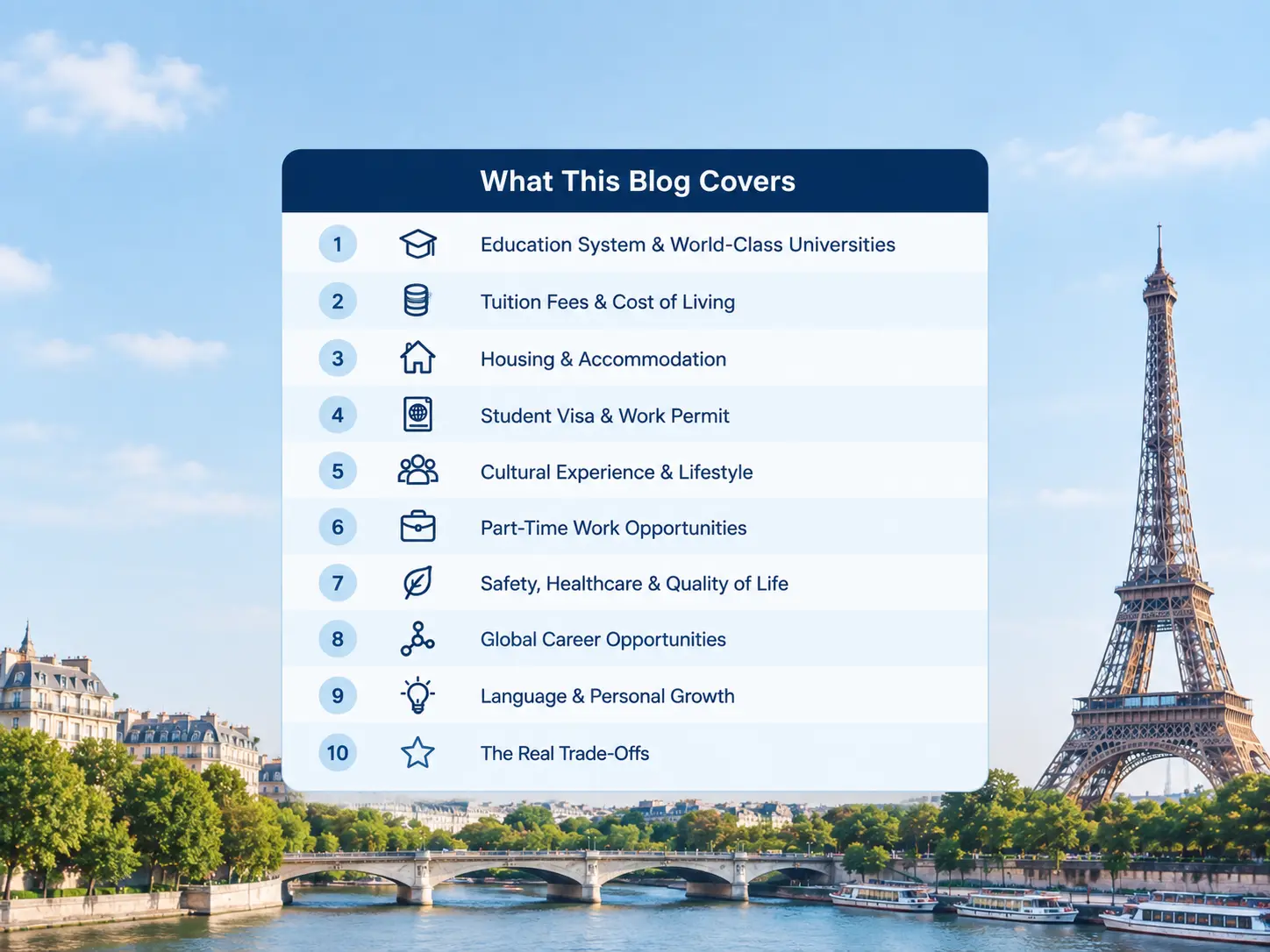
France welcomed more than 430,000 international students in 2023-24 and is working toward a national target of 500,000 by 2027. That growth isn't happening by accident, it reflects genuinely strong rankings, a real post-study work pathway, and an active government strategy to compete for students against the UK, US, Germany, and Australia. But 2026 has also brought real changes worth knowing before you commit: new tuition fees for non-EU students, a major cut to housing aid, and a sharp rise in the visa's financial proof requirement. Here are ten honest reasons to study in France, with the trade-offs included.
Reason 1: Cost Still Beats the Big Alternatives, Even After the 2026 Fee Increase
From September 2026, most new non-EU students at public universities pay differentiated tuition for the first time as a mandatory national rule rather than a university choice: €2,895 a year for a bachelor's degree and €3,941 a year for a master's. Doctoral students are unaffected and continue to pay the same €398 as French and EU students. Universities can still exempt up to 30% of their international intake, mostly scholarship holders and students facing genuine hardship, but the blanket, discretionary waivers that many universities offered until now are gone.
Even with this increase, France remains dramatically cheaper than the main alternatives:
TUITION COMPARISON
| Country |
Typical Annual Tuition (Public/State, Undergrad) |
Note |
| France (from Sept 2026) |
€2,895 (bachelor's) / €3,941 (master's) for new non-EU entrants |
Doctoral fees stay the same as EU/French students (€398);
up to 30% of a university's international intake can still be exempted
|
| Germany |
€0–1,500/semester at most public universities |
Baden-Württemberg is a notable exception charging non-EU students directly
|
| United Kingdom |
Roughly £15,000–£25,000 (~€17,500–€29,000) |
No tuition cap for international students; varies widely by university and subject
|
| United States |
Roughly $25,000–$55,000+ |
Public university out-of-state/international rates;
private universities are often higher
|
| Australia |
Roughly AUD 25,000–45,000 (~€15,000–€27,000) |
Varies significantly by state and institution
|
The honest part: this is a real cost increase, roughly 16 times the previous nominal fee, and it landed in the middle of the 2026/27 application cycle, catching some applicants off guard. Grandes Écoles and business schools were never part of this public university system and set their own fees independently, often €15,000 to €45,000 or more per year for elite MBA and Master's programmes.
Reason 2: 1,600+ English-Taught Programmes, But Know the Real Scope
France now offers more than 1,600 programmes taught entirely in English, a genuine transformation from a decade ago when French fluency was assumed for almost everything. This is real and growing fastest at Master's level and in business and engineering schools.
The honest part: 1,600+ sounds enormous, but it's a fraction of the thousands of programmes France offers overall, and the great majority of Bachelor's degrees, particularly at public universities, are still taught in French. If you're applying to an English-medium Master's or MBA, you're in a strong, well-served market. If you're hoping to do an entire Bachelor's degree in English at a public university, your options are real but noticeably more limited.
Reason 3: World-Class Rankings That Go Beyond the Paris Postcard
France placed 35 universities in the QS World University Rankings 2026, with four in the global top 100:
GLOBAL RANKINGS
| Institution |
QS World Rank 2026 |
Note |
| Université PSL |
28th |
France's highest-ranked university for the 4th year running;
in the global top 30
|
| Institut Polytechnique de Paris |
41st |
Up 5 places; ranked 25th worldwide for employer reputation
and employment outcomes
|
| Université Paris-Saclay |
71st |
Up 3 places; strong gains in sustainability and
student-to-faculty ratio
|
| Sorbonne Université |
72nd |
One of 35 French universities in the QS 2026 rankings overall
|
The honest part: these top rankings are concentrated in and around Paris. Regional universities are often excellent for cost, community, and specific fields, but they don't carry the same global name recognition, worth factoring in if a globally recognisable university name matters for your career plans.
Reason 4: Genuinely Elite Business Education, If That's Your Path
If an MBA or Master in Management is the goal, France is one of the strongest countries in the world to do it in, not just in Europe:
GLOBAL MBA RANKINGS
| School |
QS Global MBA 2026 |
FT Global MBA 2026 |
Note |
| HEC Paris |
5th worldwide (1st in Europe) |
6th worldwide |
95% international students, 71% international faculty
|
| INSEAD |
8th worldwide |
2nd worldwide |
Campuses in France and Singapore; GMAT/GRE mandatory, no waiver
|
France placed 11 schools in the QS Global MBA Rankings 2026 and 7 in the Financial Times' global top 100, two of them (HEC Paris and INSEAD) in the FT's top 10.
Dimensions France Tip: Elite Doesn't Mean Cheap or Test-Free
GMAT or GRE is mandatory at HEC Paris and INSEAD regardless of any English-test waiver, and MBA tuition at this tier commonly runs into the tens of thousands of euros. Budget and test prep both need to start early if this is your target.
Reason 5: A Real Post-Study Work Permit, Not Just a Promise
Graduates can apply for the recherche d'emploi / création d'entreprise residence permit, still widely known by its older name, APS, which allows up to 12 months in France to look for a job or start a business connected to your field of study. The labour market test, the requirement that an employer prove they couldn't find a French or EU candidate, is waived for APS holders, a genuine practical advantage over some competing countries. Once you secure a role paying at least 1.5 times France's minimum wage (roughly €2,800 a month gross in 2026), you can convert to a full Salarié or Passeport Talent work permit.
The honest part: 12 months is the standard duration, and while some nationalities, including India, have accessed extensions under bilateral migration agreements in the past, exact terms change and should always be confirmed directly with your prefecture, not assumed from older blog posts. The job you find should also generally relate to your field of study for a smooth conversion, and outside large international employers, workplace French is often expected in practice even when your degree was taught entirely in English.
Reason 6: One Visa, 29 Countries Within Reach
France's long-stay student visa gives you residence in France itself, and because France is one of 29 countries in the Schengen Area as of 2026 (following Bulgaria and Romania's full accession in January 2025), you can travel visa-free across all of them for short visits without applying for separate tourist visas each time.
The honest part: your French residence permit lets you live and study in France specifically. In every other Schengen country, you're still limited to the standard 90 days within 180 days short-stay rule that applies to any visitor, it's not unlimited travel, just visa-free travel within that limit.
Reason 7: A National Strategy Actively Trying to Recruit You
Since 2018, France has run Bienvenue en France (also branded "Choose France"), a national strategy explicitly aimed at growing international enrolment from roughly 300,000 to 500,000 students by 2027. In practice this has meant a simplified visa process through the France-Visas portal, priority processing for student applications, a formal quality label for institutions with strong international student services, and continued expansion of English-taught programmes.
The honest part: this same strategy is also the direct source of the 2026 tuition increase, the government is trying to fund quality improvements and growth partly by raising fees for new non-EU entrants, a real tension between welcome and pay more that's worth understanding rather than glossing over.
Reason 8: Genuinely Lower Cost of Living Outside Paris, With One Important Caveat
Monthly living costs run roughly €800 to €1,000 in cities like Lyon and Toulouse, versus €1,200 to €1,500 in Paris, a real and meaningful difference if you're choosing between cities. Public transport, healthcare through the French system, and CROUS student restaurants (a full meal for around €3.30) all help stretch a student budget further than in many comparable countries.
Important 2026 Change: CAF Housing Aid Is Narrowing
From 1 July 2026, CAF's personalised housing aid (APL) is only available to EU/EEA/Swiss nationals and non EU students holding a French government scholarship. Most non-EU, non-scholarship students, likely the majority of readers of this guide, are no longer eligible. If this affects you, budget an extra €100–250 a month that you may previously have expected to offset with this aid.
Reason 9: A Genuine Cultural and Lifestyle Upgrade, Not Just a Line on a Brochure
This is the hardest reason to quantify but often the one graduates mention most: world-class art, architecture, food, and a central European location that makes weekend trips to five other countries genuinely realistic on a student budget. Studying in France means access to a culture most people spend a lifetime saving up to visit briefly, not just a place to earn a degree.
The honest part: this is subjective, and culture doesn't pay rent. Weigh it as a real quality of life factor alongside the financial and career reasons above, not a substitute for them.
Reason 10: A Large, Established International Community Across Your Region
France has been actively building ties with specific regions for years, and it shows in enrolment growth: sub-Saharan African enrolment has grown particularly fast in recent intakes, and India has been named a strategic priority market, with a government target of 30,000 Indian students in France by 2030, up from roughly 10,000 today. The QS Global MBA Rankings 2026 specifically praised French business schools for diversity, citing strong female representation and international mix in both students and faculty.
The honest part: a large national community doesn't guarantee an easy social landing in your specific city or programme, community size varies significantly by location, and building a genuine local network still takes real effort in the first few months.
The Honest Downsides, All in One Place
If you've read this far, you've already seen most of these woven into the reasons above. Here they are together, because a genuinely useful why France guide should let you weigh the real trade-offs in one place, not bury them:
THE HONEST TRADE-OFF
| The Honest Trade-Off |
What It Means for You |
| Tuition just went up for new non-EU students |
From September 2026, most new non-EU bachelor's and master's students at public universities pay differentiated fees for the first time as a mandatory rule, not a university choice. |
| CAF housing aid (APL) is being cut for most non-EU students |
From 1 July 2026, only EU/EEA/Swiss nationals and non-EU students holding a French government scholarship remain eligible; budget an extra €100–250/month if you don't qualify. |
| Financial proof for the visa rose sharply in 2026 |
The minimum jumped from €615 to €877.50 per month as of 1 August 2026, a genuine increase in what you need to show upfront. |
| French bureaucracy has a real learning curve |
OFII validation, CAF, CPAM, and prefecture appointments all take patience; budget more time than you'd expect for admin in your first term. |
| English gets you far, but not everywhere |
Outside major cities and international companies, everyday life, part-time work, and some administrative interactions still favour French speakers. |
Final Thoughts
France's case for 2026 is real: genuinely strong rankings beyond the Paris hype, elite business education if that's your path, a workable post-study route into employment, and a government actively trying to make the process easier. It's also a country in the middle of real policy change, higher tuition for new non-EU students, narrower housing aid, and a steeper financial proof requirement, all landing in the same twelve months. None of that erases the case for France. It just means the honest version of "why study in France" includes both halves of the picture, and you're now looking at both.
DIMENSIONS FRANCE
Want the Full Picture for Your Specific Situation?
Fees, scholarships, housing aid eligibility, and work permit rules all vary by nationality and programme.
Dimensions France can map out exactly what 2026's changes mean for you.
Contact Dimensions France
www.dimensionsfrance.com | contact@dimensionsfrance.com