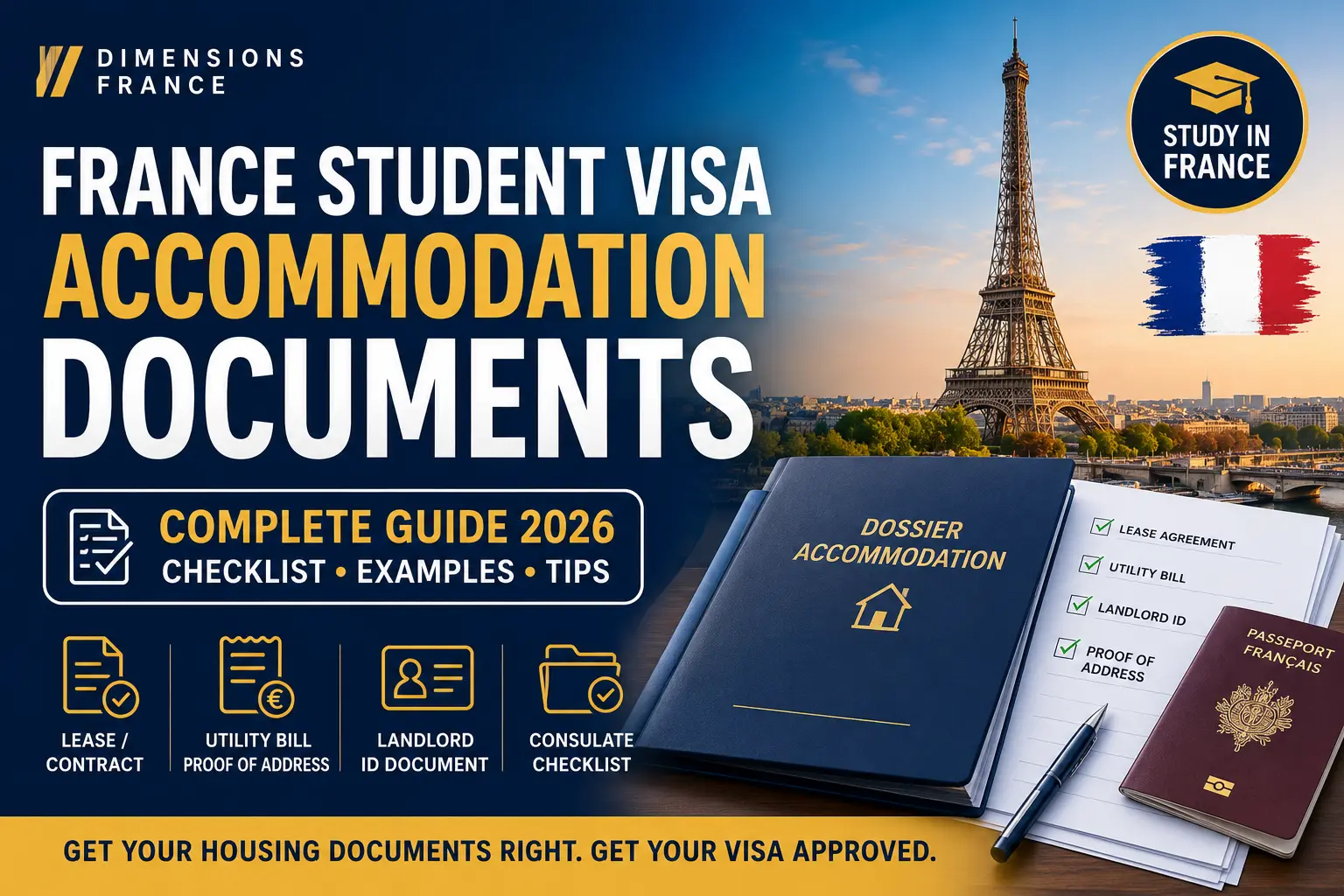
The 3 Housing Documents You Need for Your France Student Visa And Exactly How to Get Them Right
(Lease Contract · Utility Bill · Landlord Identity: 2026 Complete Guide)
Your housing document is one of the most critical files in your French student visa application. Miss a signature, submit the wrong type of bill, or forget the landlord's ID and your entire application can be delayed or rejected, pushing back your university start date by months.
The good news: once you know exactly what French consulates need, this part of the process is completely manageable. This guide breaks it down into three core documents, explains precisely what must be in each one, covers every accommodation scenario you might face, and tells you the most common reasons applications get rejected, so you can avoid all of them.
| Documents Required |
Most Common Rejection Reason |
Utility Bill Max Age |
Landlord ID Required? |
| 3 Core + Supporting Documents |
Unsigned or Incomplete Lease |
3 Months Old |
Yes — Always Required |
* All documents in a language other than French or English require a certified translation. See Section 6.
1. Why Housing Documents Matter So Much for Your Visa ?
The French student visa (VLS-TS Etudiant, Visa de Long Séjour valant Titre de Séjour) requires proof that you have a place to live in France for at least the first period of your stay. This is not just a formality. French consulates use your housing document to verify three things:
• Your address in France: where you will actually be living when you arrive.
• The legitimacy of your accommodation: that it is a real property with a real, identifiable landlord or institution.
• Your legal right to occupy it: that you are named as a tenant or confirmed resident, not just claiming an address.
Your housing proof is also directly linked to your visa timeline. Universities in France often require proof of accommodation before issuing your enrollment certificate (attestation d'inscription) and you need that certificate for the visa too. Sort your housing first, and the rest of the dossier follows much more smoothly.
Critical Timing Warning
French consulates typically require your housing to be confirmed for at least your first three months in France. The lease start date must align with or precede your intended arrival date. A lease that begins two months after your visa appointment date will be rejected. Book your accommodation before your visa appointment, not after.
2. The Different Types of French Lease, Know Which One You Have
Before you can collect the right documents, you need to understand which type of rental contract (bail) applies to your situation. French law regulates lease types strictly governed by the Law of 6 July 1989, the Loi ALUR (2014), and the Loi ELAN (2018). Each type has different rules on duration, deposit, and notice.
| Lease Type (Bail) |
French Term |
Duration |
Deposit |
Best For Students? |
| Furnished Tenancy |
Bail meublé |
1 year, auto-renewing |
2 months' rent |
✓ Yes, most common for students |
| Student-Specific Furnished Lease |
Bail étudiant |
9 months, no auto-renewal |
1 month's rent |
✓ Yes, ideal for most students |
| Mobility Lease |
Bail mobilité |
1–10 months, non-renewable |
No deposit required |
✓ Yes, ideal for short programmes and internships |
| Unfurnished Tenancy |
Bail nu (vide) |
3 years minimum, auto-renewing |
1 month's rent |
✗ Rarely suitable for international students |
| CROUS Residence |
Contrat de résidence CROUS |
Academic year (approximately 10 months) |
€150–€250 one-off |
✓ Yes, best value option if available |
| Private Student Residence Hall |
Bail résidence étudiante |
6–12 months |
1 month's rent |
✓ Yes, easiest option to secure remotely |
Which Lease Is Best for Visa Purposes?
Any of the above lease types is accepted for a French student visa, what matters is that it is signed by both parties, covers the period of your stay, and shows your name and the property address clearly. The bail étudiant (9-month student lease) and bail meublé (furnished, 1-year) are the two most commonly submitted. The bail mobilité is increasingly popular for short-programme and internship students.
3. The 3 Core Housing Documents: What They Are and What Must Be in Them ?
Here is the exact breakdown of each of the three housing documents French consulates require, what must appear in each one, and the most common mistakes to avoid.
| Document |
What Must Appear on the Document |
|
01. Legal Lease Agreement (Bail de Location)
Also called: Contrat de bail • Bail meublé • Bail étudiant • Bail mobilité
|
- Your full legal name exactly as shown on your passport.
- Signatures of both the tenant and landlord (wet signature or certified electronic signature).
- Landlord's full name and contact details.
- Date of signing on all signature pages.
- Complete property address (street number, street name, postcode and city).
- All pages present, legible and fully visible.
- Lease start date and end date (or auto-renewal clause).
- Monthly rent amount in euros and any additional charges.
- Security deposit amount (if applicable).
- If signed electronically, include the DocuSign, Yousign or equivalent audit certificate page.
- If staying in CROUS housing, provide the official CROUS residence contract or convocation letter.
- If staying in a private student residence, provide the signed contract on the residence provider's official letterhead.
|
The Single Most Common Rejection Reason
The lease is unsigned by the landlord or signed by the student only. An unsigned bail has no legal standing under French law and will be rejected by the consulate immediately. If your landlord signed electronically, you MUST include the full certificate/audit page from DocuSign or Yousign, a PDF without it looks unverified. Never submit a lease template that has not yet been countersigned.
| Document |
What Must Appear on the Document |
|
02. Utility Bill / Proof of Address (Justificatif de Domicile)
Also called: Facture EDF • Facture Internet • Justificatif de domicile du propriétaire
|
- Issued in the landlord's name (or residence/CROUS institution name).
- Shows the full property address exactly matching the lease agreement.
- Dated within the last 3 months before your visa appointment.
- Accepted bill types: electricity, gas, internet/broadband, or landline telephone.
- All names, addresses, dates and issuer information must be clearly legible.
- If electronically generated, include the complete document with the provider's header and account details.
- Home insurance certificate (Attestation d'Assurance Habitation) is also accepted.
- Rent receipts (Quittance de Loyer) may be used as supporting documents alongside the lease agreement.
- NOT accepted: Mobile phone bills.
- NOT accepted: Bank statements.
- NOT accepted: Tax notices (Avis d'Imposition) as a standalone proof of address.
|
Accepted and rejected bill types at a glance:
| Bill Type |
French Term |
Accepted? |
Key Requirement |
| Electricity |
Facture EDF / Électricité |
✓ Yes (Preferred) |
Must show the property address and subscriber name. Maximum age: 3 months. |
| Gas |
Facture de Gaz (ENGIE, TotalEnergies, etc.) |
✓ Yes |
Must show the property address and subscriber name. Maximum age: 3 months. |
| Internet / Broadband |
Facture Internet / Box (Orange, Free, SFR, Bouygues) |
✓ Yes |
Must show the property address and subscriber name. Maximum age: 3 months. |
| Landline Telephone |
Facture Téléphone Fixe |
✓ Yes |
Must show the property address and subscriber name. Maximum age: 3 months. |
| Mobile Phone Only |
Facture Téléphonie Mobile |
✗ No |
Mobile-only bills do not prove a fixed residential address and are not accepted. |
| Water Bill |
Facture d'Eau |
✓ Sometimes |
Accepted by many consulates, but requirements vary. Verify with your local consulate. |
| Home Insurance |
Attestation Assurance Habitation |
✓ Yes |
Accepted as proof of address if all required names and address details appear. |
| Rent Receipt |
Quittance de Loyer |
✓ Supporting |
Useful as supporting evidence of occupancy, but should accompany the lease agreement. |
What If the Bills Are Not in the Landlord's Name?
This is common in flatshares and newer builds where utilities are managed by a building management company. In this case, ask your landlord for:
1) a letter on their personal letterhead or signed statement confirming the address and their identity as owner
2) a copy of their property tax notice (taxe foncière) this is issued by the French tax authority in the property owner's name and is universally accepted by consulates as proof of property ownership and address. Always combine this with their ID document.
| Document |
What Must Appear on the Document |
|
03. Landlord Identity Document (Pièce d'Identité du Propriétaire)
Also called: CNI propriétaire • Passeport propriétaire • Titre de séjour propriétaire
|
- A clear, full-colour copy of the landlord's valid identity document.
- Accepted documents: French National Identity Card (CNI), passport (any nationality), or valid residence permit (titre de séjour).
- The document must be valid and unexpired at the time of your visa application.
- If using a French National Identity Card (CNI), both front and back sides must be included.
- The scan or photograph must be fully legible with no shadows, blur, cut-off edges, or missing information.
- No notarisation or certification is required for the ID copy itself; a clear colour scan is sufficient.
- If the landlord is a company, agency, or student residence operator, provide a KBIS company registration extract instead of a personal ID document.
- KBIS extracts must be issued within the last 3 months.
- If your accommodation is through CROUS, a landlord identity document is generally not required because CROUS is a public institution.
- Some French consulates may request a signed declaration from the landlord alongside the identity document. Verify local requirements before your appointment.
|
Why Landlords Are Sometimes Reluctant to Share ID
Some landlords, particularly private individuals renting remotely are cautious about sharing passport copies with tenants they haven't met. If your landlord hesitates, explain that this is a standard requirement of the French consulate process and that the document is only submitted as part of an official visa application. Most landlords who rent to international students are familiar with this request. If they still refuse, their property ownership tax notice (taxe foncière) can serve as an alternative at many consulates, confirm with yours first.
4. Your Situation, Your Documents: Scenario by Scenario
Different accommodation types require slightly different document combinations. Use this table to identify exactly what you need to submit based on your specific situation:
| Your Situation |
Document 1 (Lease) |
Document 2 (Utility / Proof) |
Document 3 (Landlord ID) |
| You Have Your Own Lease in Your Name |
Signed bail (lease agreement) showing your name as tenant. |
Utility bill for the property in the landlord's name (maximum 3 months old). |
Copy of the landlord's passport or French national ID card (CNI). |
| CROUS University Accommodation |
CROUS residence contract or official convocation letter. |
CROUS confirmation letter showing the accommodation address. |
Not required — CROUS is a public institution. |
| Private Student Residence Hall |
Signed residence contract from the provider. |
Booking confirmation and/or official address confirmation on provider letterhead. |
KBIS company registration extract or provider identity document (requirements vary by consulate). |
| Living with a Host (Family or Friend) |
Attestation d'hébergement signed by the host. |
Host's utility bill showing their name and address (maximum 3 months old). |
Copy of the host's passport, national ID card, or residence permit. |
| Colocation (Flatshare) — Your Name Is on the Lease |
Signed bail with your name listed as a tenant. |
Utility bill in the landlord's name or a named co-tenant's name. |
Copy of the landlord's passport or French national ID card (CNI). |
| Colocation (Flatshare) — Your Name Is NOT on the Lease |
Attestation d'hébergement from the named tenant. |
Named tenant's utility bill (maximum 3 months old). |
Landlord's ID document plus the named tenant's ID document. |
If You Don't Have Permanent Housing Yet
French consulates understand that some students book temporary accommodation while searching for a permanent flat. A confirmed booking for at least your first 2–3 months (hotel, student hostel, or short-term furnished rental via a verified platform like Studapart or HousingAnywhere) is generally acceptable. Some consulates especially in countries where Campus France is mandatory will require a 12-month lease. Always check your specific consulate's requirements at france-visas.gouv.fr before submitting.
5. The Attestation d'Hébergement: When and How to Use It
If you will be staying with a host (friend, relative, or contact) who is already resident in France, you do not need a lease in your own name. Instead, you submit an attestation d'hébergement, a formal hosting declaration. This is a completely valid form of housing proof for a French student visa.
The attestation must include:
• Host's full legal name, date and place of birth, nationality, and complete address in France.
• Your full name as the person being hosted.
• The address of the accommodation where you will be staying.
• The expected start date of your stay and its planned duration.
• A statement that you will be accommodated free of charge, this is required. If rent is being charged, this route does not apply.
• The host's handwritten signature and date.
Documents the host must attach alongside the attestation:
• Host's valid identity document: passport, CNI, or valid titre de séjour (residence permit).
• Host's utility bill: electricity, gas, internet, or phone bill in their name, at the same address, dated within 3 months.
• Proof of host's right to occupy the property: their own lease (bail) if they are a tenant, or property deed / taxe foncière if they are the owner.
Where to Download the Official Template ?
There is no single mandatory national template for the attestation d'hébergement for visa purposes (unlike the attestation d'accueil for Schengen short-stay visas, which is an official mairie form). For a long-stay student visa, a clearly written and signed letter covering all the points above is sufficient. Dimensions France provides a ready-to-use template for all students we work with, contact us if you need one.
6. Translation Rules: When You Need a Certified Translator
French consulates accept housing documents in French or English only. If your lease, landlord's ID, or utility bill is in any other language: Arabic, Hindi, Chinese, Portuguese, Spanish, or any other, you must have it translated by a traducteur assermenté (sworn / certified translator officially recognised by a French Court of Appeal).
• What needs translating: any document not already in French or English including the landlord's passport if it is not in a Latin script.
• What does not need translating: documents already in French or English (even if the landlord is foreign), utility bills from French providers (always in French), CROUS documents.
• How to find a sworn translator: search the official directory at repertoire.translators.pro or ask your nearest French consulate or Alliance Française for a recommended list.
• Cost: typically €40–€100 per document page. Budget for this when planning your visa timeline.
• What to submit: both the original document AND the certified translation, stapled or combined together.
7. Why Housing Documents Get Rejected And How to Avoid It ?
Housing document errors are among the top reasons French student visa applications are delayed or refused. Here are the most common mistakes and exactly how to fix them:
| Rejection Reason |
Why Consulates Refuse It |
How to Fix It |
| Lease Not Signed by Landlord |
An unsigned lease has no legal standing and cannot be used to prove accommodation. |
Request a wet signature or certified electronic signature (DocuSign, Yousign, etc.). |
| Student's Name Not on the Lease |
The lease proves accommodation for someone else, not for the visa applicant. |
Provide an Attestation d'Hébergement from the lease holder together with their identity document. |
| Utility Bill Older Than 3 Months |
Consulates require recent proof that the accommodation is currently occupied. |
Obtain a new utility bill dated within 30 days of your visa appointment whenever possible. |
| Mobile-Only Phone Bill Submitted |
Mobile phone bills do not prove a fixed residential address. |
Replace it with an electricity, internet, gas, landline, or accepted proof-of-address document. |
| Landlord ID Missing or Expired |
The consulate cannot verify who is providing the accommodation. |
Request a clear copy of the landlord's valid passport, national ID card, or residence permit. |
| Lease Dates Do Not Cover the Visa Period |
The accommodation evidence ends before the period covered by the student visa. |
Extend the lease or obtain a signed renewal/continuation letter from the landlord. |
| No Certified Translation |
Documents in languages other than French or English cannot be properly reviewed by visa officers. |
Use an official sworn translator (traducteur assermenté) for all non-French and non-English documents. |
| Electronic Signature Not Certified |
Digital leases without a verification certificate may be treated as unverifiable documents. |
Include the complete DocuSign, Yousign, or equivalent audit/certificate page when submitting the lease. |
8. Your Final Pre-Submission Checklist
Before you submit your visa file, go through this checklist for every housing document:
| Final Visa Accommodation Checklist |
Verify Before Your Appointment |
|
Lease / Contract
|
- ✓ My full name appears on the lease exactly as shown on my passport.
- ✓ Both parties have signed the lease — landlord and tenant.
- ✓ Landlord's full name and contact details are included.
- ✓ Complete property address is shown (number, street, postcode, city).
- ✓ Lease start date covers my intended arrival date in France.
- ✓ If signed electronically, the DocuSign/Yousign certificate page is included.
- ✓ All lease pages are present, complete, and fully legible.
- ✓ If using CROUS accommodation, the official CROUS contract or convocation letter is included.
|
|
Utility Bill / Justificatif de Domicile
|
- ✓ Utility bill is in the landlord's name (or institution name).
- ✓ Document type is electricity, gas, internet, or landline bill (not mobile phone only).
- ✓ Address on the bill matches the lease address exactly.
- ✓ Utility bill is dated within the last 3 months.
- ✓ All names, dates, and address details are fully legible.
- ✓ If no utility bill is available, a taxe foncière plus landlord letter is included where accepted.
|
|
Landlord Identity Document
|
- ✓ Full-colour copy of landlord's passport, CNI, or valid titre de séjour.
- ✓ Identity document is still valid and not expired.
- ✓ Both sides are included if using a French national identity card (CNI).
- ✓ If the landlord is a company, a KBIS extract dated within the last 3 months is included.
- ✓ If accommodation is through CROUS, landlord ID is generally not required.
- ✓ Scan is clear, complete, and free from shadows, blur, or cut-off corners.
|
|
Translations & Extras
|
- ✓ Every document not in French or English has a certified (assermenté) translation.
- ✓ Original document and certified translation are submitted together.
- ✓ If using an Attestation d'Hébergement, the host's ID, utility bill, and occupancy proof are attached.
- ✓ All printed documents are clear and easy to read.
- ✓ Physical copies are not folded, damaged, or stapled through important text.
|
Final Thoughts
Getting your housing documents right is not complicated, it just requires knowing exactly what is needed, collecting everything in the right format, and submitting it in the right order. The three core documents: your signed lease, a utility bill in the landlord's name dated within three months, and a clear copy of the landlord's valid identity document are what every French consulate needs to confirm your accommodation.
Start this process early. Book your accommodation 2–3 months before your visa appointment, collect the three documents as soon as the lease is signed, and check each one against the checklist in Section 8 before you submit. A clean housing dossier means a faster decision and a smoother start to your journey in France.
Dimensions France
Need Help Getting Your Housing Documents Right?
French student visa applications require more than just finding a place
to stay. Your accommodation documents must meet specific consular
requirements, including a valid lease, proof of address, and landlord
documentation.
Dimensions France helps international students secure visa-compliant
accommodation and prepare a complete housing dossier for their visa
application. From lease verification and landlord documents to
accommodation support and visa preparation, our team helps you get
your file ready before submission.
Students from over 25 countries worldwide have trusted
Dimensions France with their study abroad journey.
Contact Dimensions France
Dimensions France