June 2, 2026
Do You Really Need to Speak French to Study in France? (2026 Guide)
Can you study in France without speaking French? Honest answer on English programmes, language requirements, free learning tools & TCF/DELF exam guide 2026.

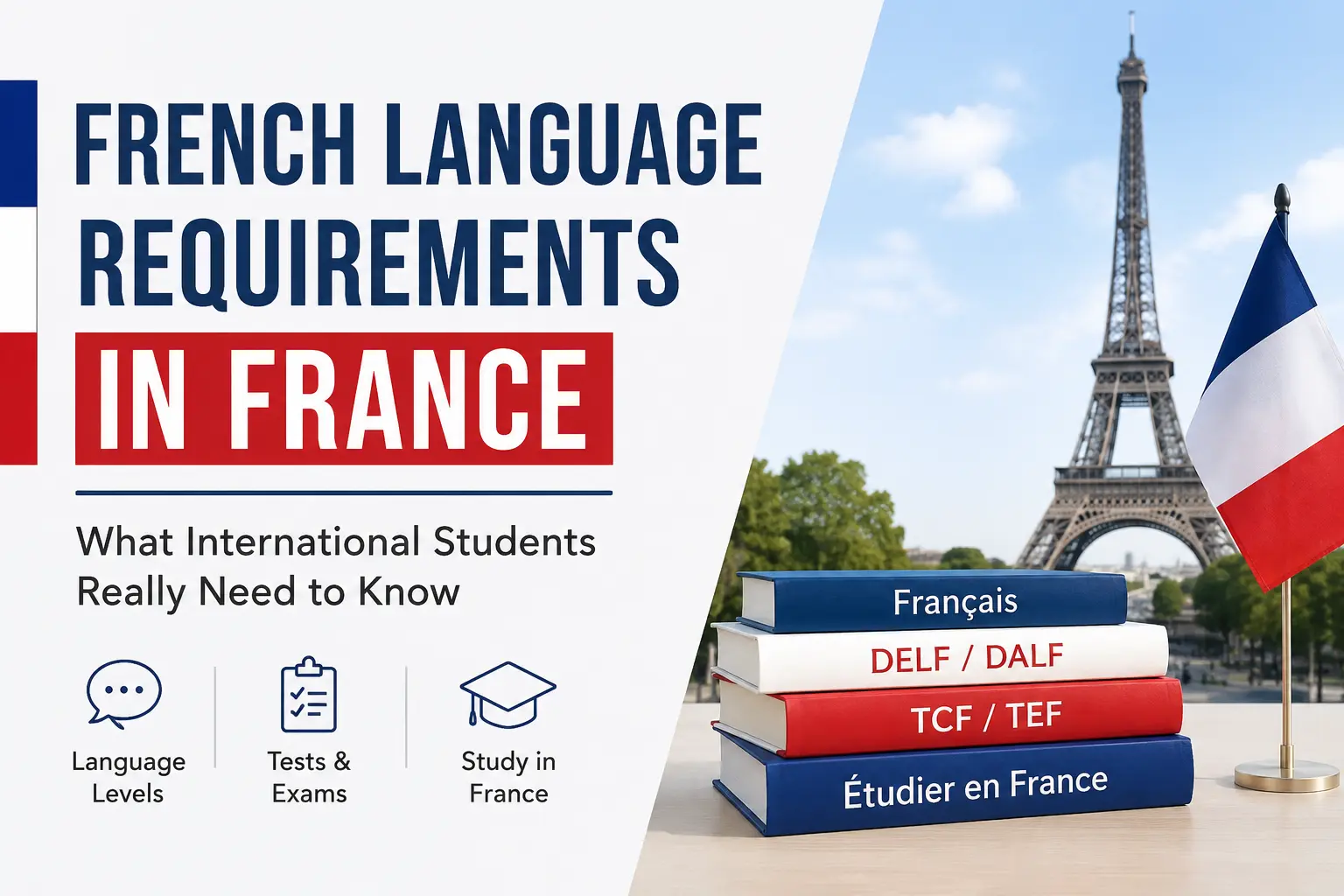
It's the question every non-French speaker asks before applying: Do I actually need to speak French to study in France? The honest answer is: it depends and probably less than you think, especially if you're targeting an English taught Master's or MBA.
France now has over 1,600 degree programmes taught entirely in English, spanning undergraduate, postgraduate, and professional levels. But daily life, administration, and your long-term visa status are a different matter. This guide gives you the full picture so you can plan your language preparation intelligently and not waste time worrying about something that may not even apply to your programme.
More than you might expect. According to Campus France, there are now over 1,600 degree programmes in France taught entirely in English including more than 115 undergraduate programmes, over 1,300 Master's programmes, 73 short and professional courses, and 125 summer schools. That number has grown significantly over the past decade as France has worked to attract international talent.
The English taught programmes are concentrated at Master's level and in the Grandes Ecoles system, elite business and engineering schools like HEC Paris, INSEAD, ESSEC, and EDHEC. At Bachelor's level, the majority of programmes at public universities (universites) are still delivered in French, so your options depend heavily on what and where you want to study.
Search English-taught programmes directly on mastersportal.eu, campusfrance.org, or the university's own website. Filter by language of instruction: English. Always confirm with the admissions office, language requirements can change each intake year.
Even if your degree is taught entirely in English, you will live in France and France is not an English speaking country. Studies show that fewer than 40% of the French population speak English at any level, and a much lower percentage are genuinely comfortable in it. Shops, public services, landlords, banks, and administrative offices will default to French.
Here's a realistic breakdown of what you'll encounter and what language level helps:
You can survive the first few weeks on English + Google Translate. But students who arrive with even basic A1-A2 French settle in faster, feel less isolated, and handle admin tasks far more confidently. Aim for A2 before you land, it takes 3 to 4 months of consistent practice and is very achievable.
For the initial student visa (VLS-TS Etudiant), France does not require you to prove French language proficiency. Your visa is granted based on your university acceptance, financial proof, and documentation, not your French level.
However, a significant update came into effect on 1 January 2026 from France's 2024 immigration law: language requirements now apply to residency renewals and long-term status. Specifically:
• Multi-year residence permit (carte de sejour pluriannuelle): A2 French required.
• 10-year resident card (carte de resident): B1 French required.
• French nationality / naturalisation: B2 French required (raised from B1 in 2026).
• Initial 1-year student visa: No French level required.
If you're planning to stay in France after graduation to work or continue studying, you'll need to demonstrate A2 at minimum when renewing to a multi-year permit. Students who plan ahead and reach B1 or B2 during their studies will have a significant advantage when transitioning to a post study work permit (APS).
The good news is you don't need to spend a fortune on French lessons. There are excellent free and low cost resources that can take you from zero to A2 in three to four months of consistent daily practice.
• Duolingo (Free) : The most used language app in the world. Great for building vocabulary and grammar habits through short, daily lessons. Best as a daily supplement rather than your sole resource
• TV5 Monde (Free) : French news and video content organised by CEFR level (A1 to C). Brilliant for listening comprehension and building real world vocabulary. Available at tv5monde.com/fle.
• FrenchPod101 (Free + Paid) : Structured audio and video lessons from beginner to advanced. Free access to a wide library, useful for commute friendly learning.
• Coursera / edX (Free to Audit) : University level French language courses, often free to audit. Look for Sorbonne and Universite Paris Diderot courses specifically.
• Alliance Francaise (Paid) : The gold standard for structured French instruction. Branches in most major cities worldwide. Excellent DELF/TCF preparation courses. Typically EUR 300-600 per term depending on your location.
• Tandem / HelloTalk (Free) : Language exchange apps where you practise with native French speakers in return for helping them with your language. Invaluable for speaking practice.
• University FLE courses (Free to enrolled students): Most French universities offer free French as a Foreign Language (Francais Langue Etrangere / FLE) courses to all enrolled international students. Sign up the moment you arrive, these are your best resources in the country.
Start Duolingo or FrenchPod101 the moment you receive your university acceptance. Even 15 minutes a day for 3 months builds a meaningful base. Students who arrive with A1-A2 adapt to daily life 60-70% faster than those who arrive with none, based on consistent feedback from our student community.
There are four main French language certification exams recognised in France. Here's what each one is and when you'd need it:
For university entry (French medium programmes), most institutions require DELF B2 or TCF B2. For Grandes Ecoles and competitive programmes, some ask for DALF C1. For English medium programmes, French language proof is generally not required, you'll submit an English proficiency test like IELTS (6.5+) or TOEFL (90+) instead.
For residency and long-term stay purposes (from January 2026): TCF IRN, DELF, or DALF are all accepted. DELF and DALF are lifetime diplomas, you take them once and they never expire. The TCF is a score based test valid for two years.
Practice papers and mock exams are available free at france-education-international.fr (the official body that administers TCF/DELF). Alliance Francaise and many language centres also offer dedicated DELF B2 preparation programmes, strongly recommended if you are applying to a French-taught programme.
A common mistake is assuming that because your programme is in English, you never need French certification. This is true for admission, but from 2026 onwards, if you plan to renew your residency or stay in France post-graduation, you will need A2 or higher. Build your French during your studies, not after.
The short answer is that you do not need to be fluent in French to study in France in 2026 especially if you're targeting an English taught Master's or MBA at a Grande Ecole or international university. Over 1,600 fully English medium programmes are available and growing each year.
But French matters for your daily life, your administration, your social integration, and critically, your long-term residency from 2026. Start learning early, use the free resources available, sign up for your university's FLE course the day you arrive, and build toward B1 by the end of your first year. Your future self will thank you.
Our latest news and trending topics