Career in France After Graduation: Can You Stay and Work?
Graduating from a French university is one thing. Knowing exactly how to stay, work, and build a career there is another. The good news: France has one of the most clearly structured post-graduation pathways in Europe and if you plan ahead, the route from student to working professional is genuinely achievable.
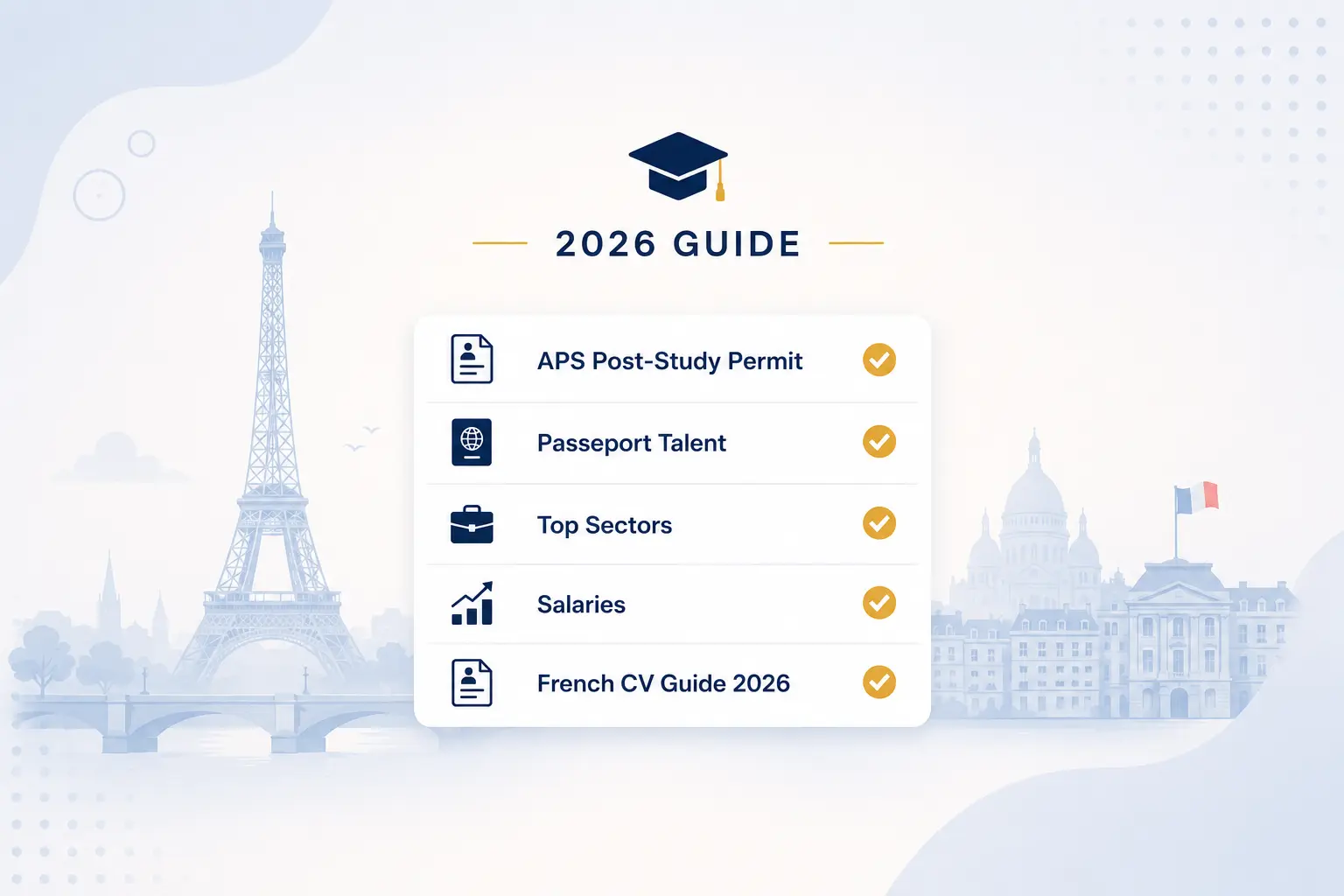
This guide covers everything you need to know in 2026: the APS post-study permit, how to convert it to a long term work permit, which sectors are actively hiring international graduates, honest salary data by field, and exactly how to write a French CV that gets noticed. Whether you want to join a CAC 40 corporation, a Paris startup, or build your own business, start here.
| APS Duration |
Work Rights (APS Year) |
Passeport Talent (Minimum Salary) |
SMIC 2026 (Gross / Month) |
| 12 Months |
Full-time employment in any sector while seeking long-term status. |
€39,582 per year (€3,298 per month) |
€1,885 per month |
Note: Passeport Talent salary threshold shown is for the Qualified Employee (Salarié Qualifié) category and is based on Decree 2025-539 applicable for 2026. SMIC figure shown is the gross monthly minimum wage effective from 1 January 2026.
1. The APS: Your 12-Month Window After Graduation
The Autorisation Provisoire de Séjour (APS), officially renamed "Recherche d'emploi ou création d'entreprise" in recent legislation is a temporary residence authorisation that gives international graduates of French institutions a full 12 month window to find employment or launch a business after completing their degree. During this period, you can work full-time in any job, for any employer, with no restrictions.
The APS is not a work visa, it is a transitional status that bridges your student permit and your long term work permit. Think of it as your runway: 12 months to land, and once you have a qualifying job offer, you convert it to a Passeport Talent or Salarié permit that lets you stay for up to four years.
Who Qualifies for the APS?
• You hold a Master's degree or equivalent (Bac+5) from a recognised French higher education institution, this includes universities, Grandes Ecoles, and engineering schools.
• You hold a valid student residence permit (titre de séjour étudiant) at the time of application, the APS must be applied for before your student permit expires.
• You have officially completed your programme, your degree must be awarded or confirmed by an attestation de réussite from your institution.
• Bachelor's degree only (Bac+3) graduates do not automatically qualify for the APS under general rules. They may qualify under bilateral agreements between France and their home country, check with your préfecture.
• There is no minimum salary requirement during the APS year itself, you can take any job, including part-time or temporary work, while searching for a permanent position.
How to Apply: Step by Step
| # |
Action |
Where / How |
Deadline |
| 1 |
Obtain your degree certificate or attestation de réussite. |
University administration (scolarité office). |
Immediately after results are published. |
| 2 |
Gather all required supporting documents. |
University, bank, landlord, and personal records. |
Allow 2–3 weeks to collect everything. |
| 3 |
Submit your APS application online. |
ANEF portal (anef.administration-etrangers.gouv.fr). |
Before your current student residence permit expires. |
| 4 |
Receive your récépissé (temporary authorisation). |
Issued digitally or by post after submission. |
Usually within a few days. |
| 5 |
Collect your APS residence permit. |
Préfecture appointment arranged through ANEF. |
Typically within 2–3 months of application. |
| 6 |
Begin your job search or launch your business project. |
Anywhere in France. |
Immediately after APS issuance. |
| 7 |
Convert APS into a Passeport Talent or Salarié permit once employed. |
Through your employer and the ANEF portal. |
Before APS expires — do not wait until the final month. |
Documents Required for Your APS Application
| Document |
Details / Notes |
| Valid Passport |
Must remain valid throughout the APS period. |
| Degree Certificate / Attestation de Réussite |
Official proof of graduation issued by your institution. Original or certified copy accepted. |
| Proof of Student Status |
Your latest student card or enrollment certificate. |
| Current Student Residence Permit (Titre de Séjour) |
The residence permit currently being converted into APS. |
| 3 Recent Passport Photographs |
35×45mm, white background, taken within the last 6 months. |
| Proof of Address in France |
Utility bill, rent receipt, or justificatif de domicile dated within the last 3 months. |
| Recent Bank Statements (3 Months) |
Showing sufficient financial resources during the APS job-search period. |
| Completed CERFA Application Form |
CERFA 11748*08 completed and signed. |
| Application Fee Payment |
Timbre fiscal. Currently €225 for a first issue; fees are expected to increase from May 2026. |
Important: Submit your APS application before your current student residence permit expires. Late applications can affect your legal status and your right to remain and work in France.
The Most Critical Timing Warning
Do NOT wait until month 10 or 11 of your student permit to apply. The APS clock starts from graduation, not from when you submit. And many students make an even bigger mistake: they wait until they have a job offer before applying for the APS. You should apply for the APS immediately after graduation, and start your job search in parallel, ideally during your final semester, before you even graduate.
2. Converting Your APS: Work Permit Pathways
The APS is not your destination, it is your transition. Once you secure a qualifying position, you apply to convert your APS into a long-term residence permit. Here are all the routes available to international graduates in 2026:
| Permit |
Best For |
Minimum Salary (2026) |
Duration |
Employer Tied? |
Family Rights? |
| APS (Recherche d'Emploi) |
Master's graduates seeking employment after graduation. |
Any salary, including minimum wage. |
12 months (non-renewable). |
No — any job permitted. |
No (temporary status). |
| Passeport Talent – Salarié Qualifié |
Graduates with a skilled job offer. |
€39,582/year (€3,298/month gross). |
Up to 4 years (renewable). |
No after the first year. |
Yes — spouse receives work rights. |
| Passeport Talent – EU Blue Card |
Highly qualified professionals in high-salary roles. |
€59,373/year (€4,948/month gross). |
Up to 4 years (renewable). |
No. |
Yes — full family rights. |
| Passeport Talent – Entrepreneur |
Graduates starting a business in France. |
€30,000 investment plus a viable business plan. |
Up to 4 years (renewable). |
Self-employed. |
Yes. |
| Passeport Talent – French Tech Visa |
Startup founders recognised by Bpifrance or French Tech. |
Innovation recognition required. |
Up to 4 years (renewable). |
Self-employed. |
Yes. |
| Salarié (Standard Work Permit) |
Any salaried position where the employer sponsors the permit. |
At least SMIC (€1,885/month gross). |
1 year (renewable). |
Yes — linked to the sponsoring employer. |
Via separate family reunification procedures. |
Note: APS is intended as a temporary post-graduation status to help graduates secure employment or launch a business in France. Once eligible employment is secured, many graduates transition to a Passeport Talent or Salarié residence permit.
Which Route Is Right for You?
For most Master's graduates with a job offer: the Passeport Talent, Salarié qualifié is the cleanest path. It requires a salary of at least €39,582/year (€3,298/month gross), a contract of at least 3 months (CDI or long CDD), and a role relevant to your qualification. It gives you 4 years, renewable, with no employer tie after year one and your spouse gets automatic work authorization.
For high earners in finance, tech leadership, or senior roles: the EU Blue Card (€59,373/year minimum) gives the same 4-year duration with added EU-wide mobility advantages.
For startup founders: the Passeport Talent, Entrepreneur or French Tech Visa route is available if you have a validated business plan and €30,000 investment, or official recognition from Bpifrance or the French Tech Mission.
3. The French Job Market: Top Hiring Sectors for International Graduates
France's 2026 labour market is characterised by a paradox: overall unemployment sits at 7.7%, yet acute skills shortages persist in technology, engineering, healthcare, and green energy. France 2030, the government's €54 billion innovation investment plan is driving hiring across AI, quantum, biotechnology, and clean energy. For a skilled, internationally educated graduate, this is an exceptionally good moment to enter the French job market.
| Sector |
Demand Level |
Graduate Starting Salary |
Key Employers |
French Level Needed |
Technology & AI
(Software, Data, Cybersecurity) |
■ Very High
80,000+ unfilled digital jobs in France (2026). |
€40,000–€60,000/year
(Software engineers often €44,873–€71,601/year). |
Capgemini, Dassault Systèmes, Mistral AI, Criteo, Doctolib, Atos, Amazon France, Google France. |
B1 helpful; English is often sufficient in tech and startup environments. |
Engineering
(Aerospace, Automotive, Energy) |
■ Very High
Supported by France 2030's €54 billion investment programme. |
€41,000–€60,875/year
(Average around €49,000/year). |
Airbus, Renault, Stellantis, Safran, TotalEnergies, Schneider Electric, Thales. |
B2 for most positions; some English-first environments at Airbus and multinational firms. |
Finance & Banking
(Investment, Asset Management, FinTech) |
■ High
Paris remains a major European finance hub. |
€45,000–€70,000/year
(Grande École graduates often €55,000+). |
BNP Paribas, Société Générale, AXA, Amundi, Natixis, and international banks. |
B2 generally required for client-facing roles; English accepted in many global firms. |
Luxury & Fashion
(Retail, Marketing, Supply Chain) |
■ High
France remains the global leader in luxury goods. |
€35,000–€52,000/year. |
LVMH, Kering, Hermès, L'Oréal, Chanel, Richemont, Sephora. |
B2–C1 strongly preferred due to customer and stakeholder interaction. |
Management Consulting
(Strategy, Operations, Digital) |
■ High
Strong recruitment from major consulting firms. |
€48,000–€65,000/year
(Top firms frequently exceed €55,000). |
McKinsey, BCG, Bain, Deloitte, Accenture, Capgemini Invent. |
B2 generally required; many firms operate bilingual teams. |
Healthcare & Pharma
(Research, Clinical, Regulatory) |
■ Very High
Aging population and continued healthcare investment. |
€37,000–€55,000/year. |
Sanofi, Servier, Ipsen, BioMérieux, Guerbet, Pfizer France, Roche France. |
C1 required for clinical roles; research positions typically require B2+. |
Green Energy & Environment
(Renewables, Climate, Engineering) |
■ Growing Fast
Major beneficiary of France 2030 investments. |
€38,000–€55,000/year. |
EDF, Engie, TotalEnergies Renewables, Veolia, Ørsted France. |
B1–B2 for most roles; increasing number of English-first project teams. |
| Business Analytics & Data Science |
■ Very High
Strong demand across nearly all sectors. |
€40,000–€65,000/year. |
BNP Paribas, LVMH, Sanofi, Capgemini, consulting firms, and startups. |
B1 often sufficient; many data teams operate primarily in English. |
Note: Salaries shown are typical graduate starting salaries in 2026 and vary by location, institution, prior experience, and employer. Paris generally offers the highest salaries, while French language requirements are often lower in technology, data, and international business environments.
The French Tech Visa: A Fast Track for Startup Talent
Companies holding official 'French Tech Visa' status including Mistral AI, Brevo, Doctolib, BlaBlaCar, and hundreds of certified startups can sponsor international talent far faster than traditional employers. The labour market test (which normally requires employers to prove no French candidate was available) is waived entirely for French Tech Visa companies. If you are in tech, AI, or data science, prioritise these employers in your search. Find the full list at lafrenchtech.com.
4. Average Salaries for Graduates by Field: 2026 Data
Here is the most up-to-date salary data available for graduate and early career professionals in France, sourced from Glassdoor (May 2026), INSEE, levels.fyi (June 2026), and recruitment agency data. All figures are gross annual salary, subtract approximately 22–25% for net (after social contributions).
| Field / Role |
Graduate Entry
(0–2 yrs) |
Mid-level
(3–5 yrs) |
Senior
(6+ yrs) |
Notes |
| Software Engineer |
€44,000–€56,000 |
€58,000–€80,000 |
€80,000–€120,000+ |
Paris premium 20–30%; levels.fyi June 2026 |
| Data Scientist / Analyst |
€40,000–€58,000 |
€58,000–€78,000 |
€75,000–€110,000 |
Finance/tech sector = upper range |
| Mechanical / Aerospace Engineer |
€38,000–€50,000 |
€52,000–€68,000 |
€68,000–€90,000 |
Airbus, Safran, Thales top payers |
| Financial Analyst |
€42,000–€58,000 |
€58,000–€80,000 |
€80,000–€130,000+ |
Paris finance hub; IB roles higher |
| Management Consultant |
€48,000–€65,000 |
€65,000–€95,000 |
€95,000–€150,000+ |
Big 4 at entry; MBB at top end |
| Marketing / Luxury Brand Manager |
€32,000–€45,000 |
€45,000–€65,000 |
€60,000–€90,000 |
LVMH, L'Oréal, Kering top payers |
| Pharmacist / Clinical Research |
€38,000–€52,000 |
€52,000–€70,000 |
€68,000–€100,000 |
French B2+ mandatory for patient roles |
| Architect / Urban Designer |
€30,000–€40,000 |
€40,000–€58,000 |
€55,000–€80,000 |
Lower entry; rising with experience |
General Master's Graduate
(all fields, national average) |
€41,000–€52,500 |
€52,500–€68,000 |
€68,000+ |
Glassdoor Graduate Programme data, May 2026 |
Understanding Gross vs Net in France
France's social contribution system means the gap between gross and net salary is significant. A €45,000 gross salary becomes approximately €34,000–€35,000 net per year (€2,800–€2,900/month). However, social contributions fund exceptional public services: universal healthcare (CPAM), generous unemployment insurance (ARE), and a state pension. When comparing French salaries to other countries, always compare net-of-contributions figures, the gross-to-gross comparison makes France look lower than it actually is in terms of real purchasing power and total compensation.
5. How to Write a French Style CV
Your Indian, African, or Asian CV will not work in France, not because your experience is insufficient, but because French recruiters have very specific format expectations and will dismiss an unfamiliar layout before reading the content. Here is exactly what French employers expect, and the most common mistakes international graduates make:
| Element |
French CV Standard |
Common International Mistake |
| Length |
1 page for fresh graduates; 2 pages maximum with experience |
Submitting a 3–4 page CV from home country format |
| Photo |
Include a professional headshot (top right corner) |
Omitting the photo, this is expected in France |
| Personal Info |
Name, address, phone, email, LinkedIn |
Including date of birth, nationality, marital status (optional but common) |
| Education |
Reverse chronological order; include institution, degree name, year, GPA if strong (>14/20) |
Listing secondary school and earlier certificates unnecessarily |
| Experience |
Role title, company, city, dates; 3–4 bullet points of achievements per role |
Listing duties only, French employers want impact and results |
| Skills |
Language levels (CEFR), technical tools, software |
Vague claims like "good with computers" or "team player" |
| Hobbies / Interests |
Include; French employers read these and often use them during interviews |
Leaving this section blank, which may appear impersonal |
| Objective Statement |
Short 2–3 line professional profile at the top is common |
Long career objective paragraphs that read like a form template |
| File Format |
PDF, always, named "NomPrenom_CV.pdf" |
Sending .doc or .docx files that may render differently |
The French Cover Letter (Lettre de Motivation)
In France, the cover letter is taken far more seriously than in most countries. A generic, copy pasted letter is immediately spotted and immediately binned. French recruiters use it to assess your written communication, your knowledge of the company, and your clarity of professional purpose. Here is what works:
• Structure: Three clear paragraphs: why this company (not just 'it is a leader in...'); why this role specifically; why you are the match. Keep it to one page.
• Tone: Formal but direct. French professional writing avoids flowery language. State your value proposition clearly.
• Opening: Address to a named person if possible: 'Madame, Monsieur' if not. Never 'To Whom It May Concern'.
• Close: Request an interview directly: 'Je serais heureux(se) de vous rencontrer pour un entretien afin de vous exposer ma motivation.'
• Language: In French for French-medium roles; in English for clearly English-first environments (many tech companies, Grandes Ecoles, international firms).
• Tailoring: Every letter must be specific to the company. Mention something real about their strategy, culture, or recent activity. This is where most international applicants lose the competition.
6. LinkedIn Strategy and Networking in France
France's professional culture is relationship driven. Who you know or who knows you, matters enormously. LinkedIn is the dominant professional platform in France with over 30 million French users, but the way French professionals use it differs from other markets. Here is what works in 2026:
• Optimise your profile in both French and English: Use a bilingual headline. Many recruiters search in French, if your profile is English-only, you are invisible to a significant portion of the market.
• Post in French when possible: Original content in French, a reflection on your sector, a comment on an industry development, a summary of a conference dramatically increases your visibility to French recruiters. Even one post a week builds reach.
• Use InMail strategically: A personalized InMail (not a template) to a relevant hiring manager at your target company, referencing a specific role or project they are working on, has a response rate several times higher than applying through a job portal alone.
• Connect with your alumni network from day one: French Grandes Ecoles networks (especially HEC, Sciences Po, ESSEC, and Polytechnique) are exceptionally strong and alumni are generally very willing to help recent graduates. Message them directly: be brief, specific, and grateful.
• Attend French Tech and sectoral meetups: Station F, BlaBlaCar's open events, French Tech Regional hubs in Lyon and Bordeaux, and industry associations (Syntec Numérique for tech, Association Française de Gestion Financière for finance) all run regular networking events where face-to-face contact can open doors that applications alone cannot.
• Follow your target employers' company pages: Comment meaningfully on their posts before applying, it increases your visibility to their recruiters and shows genuine interest.
• Use Welcome to the Jungle: This is France's LinkedIn for younger talent, a leading jobs platform where companies present their culture as well as roles. Far more popular than traditional job boards for graduate Level hiring.
Job Platforms Most Used by French Graduate Recruiters
Welcome to the Jungle (welcometothejungle.com) culturE first job platform, top for graduates and startups. LinkedIn, essential for all sectors. Indeed France, broad coverage across all levels. Cadremploi for cadre (manager/executive) level roles. Monster.fr broader but less curated. APEC (apec.fr) official platform for cadre-level roles; free and comprehensive. Your university's career centre (Bureau des Carrières / BDE Emploi) underused but highly valuable; alumni job boards and employer partnerships are gold for recent graduates.
7. Your Post-Graduation Career Timeline
Here is the realistic timeline from graduation to securing a long-term work permit. Students who plan ahead and start early dramatically outperform those who begin after graduation.
| When |
Action |
Why It Matters |
| Final semester (6 months before graduation) |
Start networking, LinkedIn outreach, and job applications in parallel with studies. |
Job searches in France typically take 3–6 months. Starting early gives you a head start before the APS period begins. |
| Final semester (3 months before graduation) |
Complete a major internship if not already done; attend career fairs; refine CV and cover letters. |
Internships frequently convert into full-time offers and are one of the fastest routes to securing a CDI after graduation. |
| Graduation month |
Apply for APS immediately upon receiving your attestation de réussite. |
Do not delay. Your student residence permit expires, and the APS application receipt (récépissé) authorizes continued legal stay. |
| APS Months 1–3 |
Conduct a full-time job search and use your récépissé to demonstrate legal work authorization. |
Many employers request proof of work eligibility before scheduling interviews or extending offers. |
| APS Months 3–6 |
Target French Tech Visa employers, expand networking efforts, and attend industry events and meetups. |
This is typically the most active hiring period, with many successful APS-to-work-permit transitions occurring within six months. |
| APS Months 6–9 |
If a job offer is secured, begin the conversion process to a Passeport Talent or Salarié residence permit. |
Permit processing can take 2–3 months, so it is important not to wait until the end of the APS period. |
| APS Month 9–10 Deadline |
Ensure your work permit application has been formally submitted. |
Late submissions may create a gap in legal status, and ANEF processing is not immediate. |
| Post-APS |
Transition to a long-term work permit and continue improving French language proficiency. |
A2 French is required for permit renewals from 2026 onward. B1 is recommended by year two, while B2 is generally needed for future naturalisation plans. |
Final Thoughts
France is one of Europe's most genuinely accessible post-study work destinations for international graduates. The APS gives you a full year, full work rights, and a clear path to a 4-year renewable permit. The job market in 2026 is actively seeking skilled graduates in technology, engineering, finance, luxury, consulting, and green energy. Average graduate starting salaries of €41,000–€52,500 are competitive for continental Europe, and the public benefits system significantly improves net real income.
The graduates who thrive are the ones who start early: job-searching in their final semester, applying for the APS the day their results arrive, and treating the 12-month window as a full-time project, not a break before the real search begins. Plan it like a campaign, build your network before you need it, get your CV right, and France will meet you more than halfway.
Planning Your Career in France After Graduation?
Dimensions France advises international students not just on
getting to France — but on building a life there.
From APS application guidance and permit conversions to CV reviews,
interview preparation, and job-search strategy, our team has helped
hundreds of graduates across Africa, Asia, and beyond navigate the
transition from student to professional in France.
Contact Dimensions France
Dimensions France
www.dimensionsfrance.com
contact@dimensionsfrance.com