Can I Study in France Without IELTS? (2026 Complete Guide)
Quick Facts
IELTS, English Taught Programmes & the 2026 Financial Proof Rule
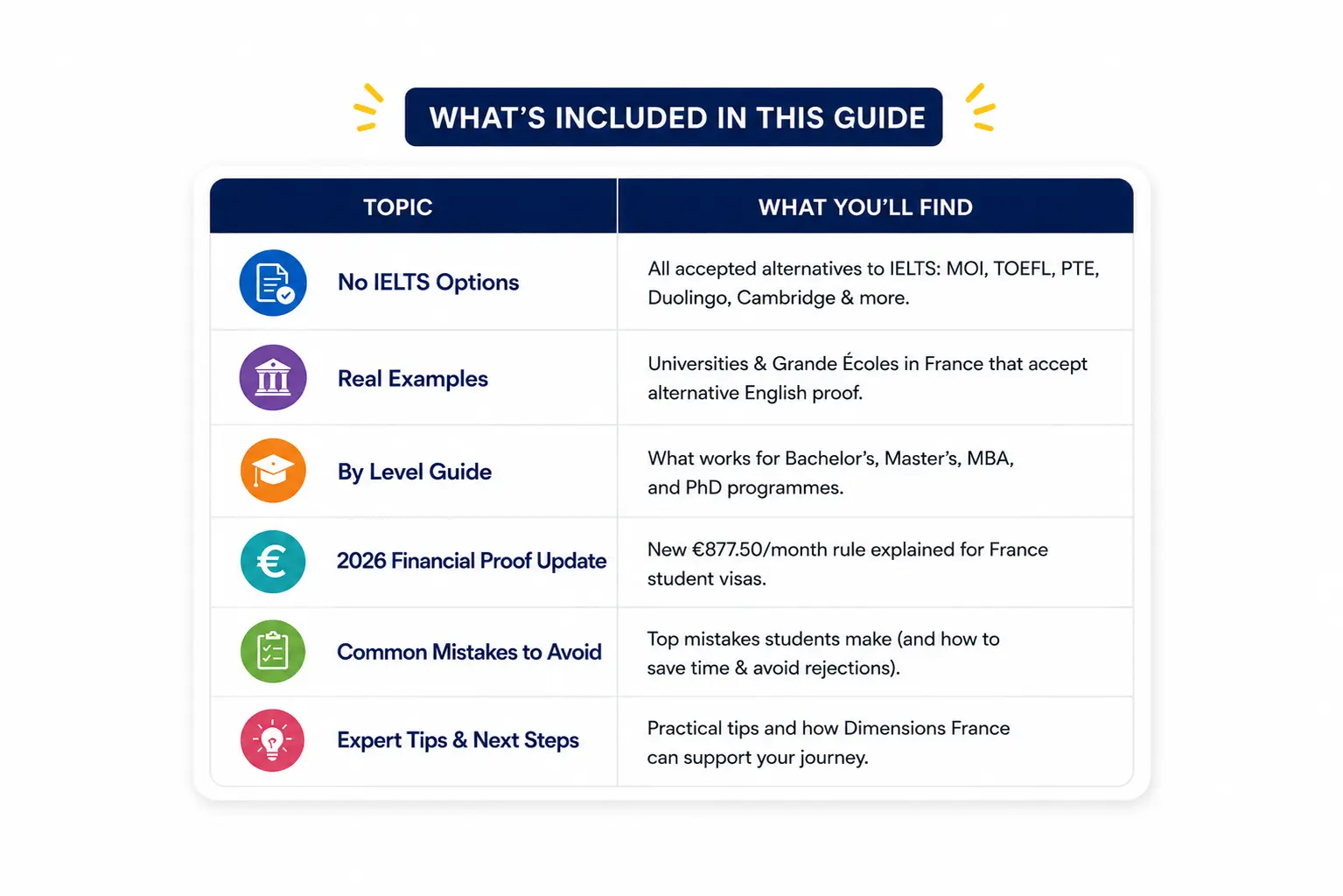
MOI certificates, TOEFL, PTE and Duolingo alternatives, real examples from named universities, and the financial proof rule that just changed.
| Is IELTS a Visa Requirement? |
English-Taught Programmes in France |
Cheapest Accepted Alternative |
2026 Financial Proof Update |
|
No
|
1,600+
|
Duolingo (DET)
|
€615 → €877.50/month
|
The short answer is yes: France does not have a single, blanket IELTS requirement, and thousands of international students enrol every year using an alternative. The honest answer is more useful, whether you personally can skip IELTS depends on your programme level, your target school, and whether your previous degree was taught in English. This guide walks through every legitimate route, with real minimum scores and named examples, so you know exactly where you stand before you spend money on a test you might not need.
1. Why This Question Causes So Much Confusion
Unlike the UK or Australia, France doesn't run a single national language testing rule for international students. Admission requirements are set by each university, Grande École, or business school individually, and the French student visa itself has no English language requirement at all, that decision belongs entirely to the institution that admits you, not to the consulate that issues your visa. That's why you'll see confident sounding "yes" and "no" answers online for the exact same question, both can be true, for different schools.
2. Your Three Real Paths to Skip IELTS
A. The Medium of Instruction (MOI) Certificate
An MOI certificate is a letter, usually on official letterhead from your previous school or university, confirming that your degree was taught and examined entirely in English. It is a waiver document, not a substitute score, it tells the admissions office you already studied in English, so they choose not to ask for a new test. Whether it's accepted is entirely up to the receiving institution, there's no country wide rule that guarantees it will work.
For an MOI certificate to hold up, it generally needs to include all of the following:
• Your full name, exactly as it appears on your passport.
• The programme name and level, for example "BSc Computer Science."
• The period of study, for example 2019 to 2023.
• An explicit statement stating English was the medium of BOTH instruction and examination, not just one or the other.
• The signature, name, and designation of an authorised official, such as the registrar.
• An official stamp or seal, plus contact details so the university can verify it if needed.
Dimensions France Tip: A Vague MOI Gets Rejected
The single most common reason an MOI certificate bounces back is a missing statement that English was also the language of examination, not just teaching. If your school's standard letter only mentions instruction, ask them to add the examination line explicitly before you submit it.
B. Standardised English Tests: TOEFL, PTE, and Duolingo
If MOI isn't available or accepted for your target programme, the next question is which test to take, and IELTS is rarely the only, or the cheapest, option. Here's what each accepted alternative actually is:
English Language Options
Alternatives to IELTS for Studying in France
| Route |
What It Actually Is |
Notes |
| Medium of Instruction (MOI) Certificate |
A letter from your previous school or university confirming your
degree was taught and examined entirely in English.
|
A waiver document, not a score. The receiving institution decides
whether to accept it, case by case.
|
| TOEFL iBT |
Standardised English test, widely accepted across France.
|
Most consistently accepted by elite Grandes Écoles and business
schools when a test is required.
|
| PTE Academic |
Pearson's computer-based English test.
|
Fast results, typically within 48 hours. Accepted at a growing
number of French institutions, including INSEAD.
|
| Duolingo English Test (DET) |
Short, at-home, AI-scored English test.
|
Cheapest and fastest widely accepted option. Adoption in France is
growing, but acceptance remains uneven at elite schools.
|
| Cambridge C1 Advanced / C2 Proficiency |
UK-based English qualification with no expiry date.
|
Useful if you already hold one; less commonly the first choice for
new applicants.
|
| IELTS Academic |
The test this guide is about avoiding.
|
Still the "safe default" and one of the most consistently listed
English tests across institutions.
|
Score Comparison
Approximate English Test Score Equivalencies
| IELTS Academic |
TOEFL iBT |
PTE Academic |
Duolingo (DET) |
Cambridge |
| 6.0 |
60–78 |
50–57 |
95–100 |
B2 First, grade B/C |
| 6.5 |
79–93 |
58–64 |
105–115 |
C1 Advanced, grade C |
| 7.0 |
94–101 |
65–72 |
120–125 |
C1 Advanced, grade B |
| 7.5 |
102–109 |
73–79 |
130–135 |
C1 Advanced, grade A |
These conversions are commonly published approximations, not official
guarantees. Always confirm the specific minimum score your target
programme accepts rather than relying on a conversion chart alone.
C. University Interviews and Internal Assessments
A smaller number of programmes, particularly at business schools, will accept a live interview, often conducted in English by an alumnus or admissions officer, as a substitute for a written test. This is decided case by case and is more common for applicants with strong professional experience in an English-speaking work environment than for students straight out of school.
3. Requirements by Programme Level
This is the table that actually matters, requirements shift significantly depending on what and where you're applying to:
IELTS Alternatives
Can You Study in France Without IELTS?
It depends on your level, university and programme. Here is a simple
guide to what you may be able to use instead.
| Study Level |
Without IELTS |
If a Test Is Needed |
Examples |
Bachelor's
English-taught
|
You may be able to use an MOI certificate showing that your
previous education was taught in English.
|
TOEFL 80+
PTE 58+
DET 105+
|
Some private universities and English-taught Licence programmes.
|
Master's
Public university
|
An MOI letter may be accepted. The university normally checks it
on a case-by-case basis.
|
TOEFL 80–90+
PTE 58–64+
DET 105–115+
|
Some English-taught programmes at Sorbonne Université and
Université Paris-Saclay.
|
Master's
Business school
|
An MOI or proof that you studied in English for around 2 years
may be accepted. Some schools may also conduct an interview.
|
TOEFL 80–90
PTE 58–65
DET 105–115
|
SKEMA, NEOMA, EDHEC, emlyon and Grenoble EM.
|
Master's
Top Grande École
|
A test may be waived if you completed 2+ years of education
entirely in English and can prove it.
|
TOEFL 90–100+
IELTS 7.0+
PTE 65–72
|
HEC Paris MiM may waive the test when your previous degree
was fully taught in English.
|
MBA
HEC, ESSEC, INSEAD, etc.
|
You may be exempt if your previous degree was fully taught in
English. Some schools have additional exemption rules.
|
TOEFL 100–105+
IELTS 7.0–7.5+
PTE 68–72+
|
INSEAD recommends TOEFL 105, IELTS 7.5 or PTE 72.
HEC Paris requires a test if you are not exempt.
|
|
PhD
|
Requirements vary by university. Some institutions offer
an exemption after 2 years of English-medium study.
|
TOEFL / IELTS / Cambridge if required by the institution.
|
HEC Paris offers exemptions in certain cases, including
sufficient previous English-medium study.
|
Important: There is no single IELTS rule for all of France.
Each university and programme can set its own English-language requirements.
Always check the requirements of your specific programme before applying.
Two patterns hold across almost every level: an MOI based waiver is far more achievable at public universities and mid-tier business schools than at elite Grandes Écoles, and even where the English test is waived, a business school's separate GMAT or GRE requirement never disappears.
4. Real Examples from Named Institutions
1. Sciences Po: Applicants are exempt from submitting an English test if they completed at least two consecutive years within the same degree programme taught entirely in English, or if their high school diploma itself was delivered in English (this covers the English A1/A2 tracks of the International Baccalaureate, among others). Even with an exemption at entry, Sciences Po still requires Master's students to reach a C1 English level by graduation.
2. HEC Paris: For the Master in Management, an English test (IELTS 7.0+ or TOEFL 100+) is only required if your previous degree was not taught in English, if it was, the requirement is waived. The same logic applies at PhD level: two or more years of an English-medium university degree qualifies you for exemption, and native English speakers are automatically exempt. For the MBA, HEC Paris accepts TOEFL, TOEIC, IELTS, PTE, Cambridge, or Duolingo from non-native speakers who don't hold an English-medium degree.
3, INSEAD: The MBA programme's official language policy recommends TOEFL 105, IELTS 7.5, or PTE Academic 72, all noticeably higher than the minimums at less selective schools, reflecting INSEAD's fast paced, discussion heavy classroom format. Exemptions are available for a university degree taught entirely in English, or an academic exchange year during which the curriculum was fully in English. The GMAT or GRE remains mandatory regardless of any language waiver.
4. Sorbonne Université and Université Paris-Saclay: Both have been reported to accept MOI certificates on selected English taught Master's programmes, alongside TOEFL iBT 80+, PTE 58+, or Duolingo 105-115+ where a test is required. As with every institution in this guide, acceptance is programme-specific, confirm directly with the department you're applying to before assuming a blanket policy.
5. What About the Student Visa?
This is the part most guides get muddled: admission and the visa are two entirely separate processes, run by two entirely separate bodies, and English testing only ever belongs to the first one.
1. Your university or Grande École decides whether to admit you, and whether to accept an MOI certificate, TOEFL, PTE, Duolingo, or nothing at all in place of IELTS.
2. Campus France / Études en France (for applicants from Campus France procedure countries) verifies your study project is coherent through the Études en France platform and an interview focused on your academic plans, not your English level.
3. The visa stage (the French consulate, via France-Visas) checks your acceptance letter, financial proof, and accommodation evidence. It does not independently test or require proof of your English ability.
In short: once you're admitted, whatever route you used to get there, MOI, TOEFL, PTE, Duolingo, or an interview, the consulate does not reopen that question. What it does check closely is your financial proof, which brings us to the most important update in this guide.
6. Important 2026 Update: The Financial Proof Requirement Has Changed
Key Update: Effective 1 August 2026
Under Décret n° 2026-526 du 22 Juin 2026, the minimum proof of financial resources for a French student visa rose from €615 per month to €877.50 per month. This applies to every student visa application submitted on or after 1 August 2026, which, if you're reading this, almost certainly includes you.
For a typical 10-month academic year, that's a jump from roughly €6,150 to about €8,775 in demonstrated funds, and for a full 12-month visa, from about €7,380 to €10,530. This applies whether you're proving funds through bank statements, a scholarship certificate, or a sponsor's financial guarantee (attestation de prise en charge). If you or your family started budgeting around the old €615 figure, which still appears on many older blog posts and even some institutional pages that haven't yet updated, revisit those numbers now, this is one of the few genuinely new rules for the 2026 intake, and it has nothing to do with your English test at all.
7. Step-by-Step: How to Apply to France Without IELTS
1. Check the official English requirement of the specific programme you want, not the university's general admissions page. Look for the exact phrase used, some say "IELTS or equivalent," others list specific alternative tests by name.
2. If your secondary school or bachelor's degree was taught entirely in English, request an MOI certificate from your institution's registrar in the exact format your target school expects, don't submit a generic letter and hope it's accepted.
3. If MOI isn't an option or isn't accepted, book the cheapest test your target programme explicitly lists as accepted, this is very often Duolingo (DET) for mid-tier institutions, or TOEFL/PTE for more selective ones.
4. Submit your application through Études en France if your country requires the Campus France procedure, or directly through the university's own international admissions portal if it doesn't.
5. If you're applying to a Grande École Master's or MBA, register for the GMAT or GRE in parallel, this requirement is separate from your English proof and is never waived by an MOI certificate.
6. Complete the EEF interview with Campus France if applicable, this interview assesses your study project's coherence, not your English level.
7. Prepare your financial proof using the current €877.50/month threshold, not the older €615 figure still circulating online, and apply for your VLS-TS visa once your acceptance letter is confirmed.
8. Common Mistakes to Avoid
Avoid These Mistakes
Common Mistakes Students Make When Avoiding IELTS
| Mistake |
Why It Costs You Time |
|
Assuming "no IELTS required" means "no English test at all"
|
It usually means an accepted alternative may be required, not
proof-free entry. Always read the exact wording on the programme page.
|
|
Requesting an MOI certificate in the wrong format
|
Missing the registrar's seal, signature, or a clear statement that
English was both the teaching and examination language can result
in rejection.
|
|
Forgetting the GMAT/GRE is separate from the English requirement
|
MBA and MiM programmes may waive the English test but still require
the GMAT or GRE.
|
|
Believing IELTS is a French government visa requirement
|
It isn't. University admission and the visa process are handled by
separate bodies with separate requirements and checklists.
|
|
Budgeting financial proof at the old €615/month rate
|
As of 1 August 2026, the minimum has risen to €877.50/month,
or roughly €10,530 for a 12-month stay. This applies to visa
applications submitted from that date.
|
|
Not re-confirming rules for your specific programme
|
Requirements can vary between programmes at the same university,
not just between different universities.
|
9. Quick FAQ
1. Is IELTS completely unnecessary for studying in France? : No, there's no blanket rule either way. Some elite Grandes Écoles and business schools still require IELTS or an equally strong alternative; many public universities and mid-tier business schools don't.
2. Can I use my 12th grade English marks instead of IELTS?: Usually not on their own. An MOI certificate generally needs to cover your most recent degree, secondary school or bachelor's, and must confirm English was the language of both teaching and examination, not just a strong grade in an English subject.
3. Does an MOI certificate also work for the visa?: The visa itself has no English-test requirement at all. MOI is purely an admissions document; once you're admitted, your visa depends on your acceptance letter, financial proof, and accommodation evidence.
4. Is Duolingo respected by top French schools?: Increasingly, yes, HEC Paris's MBA programme accepts it, for example, but acceptance still varies by school and programme, so confirm before you rely on it for a highly selective application.
5. What if I can't get a waiver and need the cheapest accepted option?: Duolingo's DET is generally the fastest and least expensive widely accepted alternative, with results typically available within about two days, though its acceptance at the most selective schools is less consistent than TOEFL or PTE.
Final Thoughts
"Can I study in France without IELTS" doesn't have one answer, it has as many answers as there are programmes in France. What's consistently true is this, an MOI certificate is your strongest, cheapest option if your prior degree was fully English medium; TOEFL, PTE, and Duolingo all have a real, growing footprint even at business schools; the visa itself was never checking your English in the first place; and the number actually worth double checking before you apply is your financial proof, now €877.50 a month as of 1 August 2026, not your IELTS score.
DIMENSIONS FRANCE
Not Sure Which Route Applies to You?
Every programme sets its own English-language requirements. Dimensions France can check your specific target university, confirm whether an MOI certificate may be accepted, and help you understand the latest 2026 visa financial-proof rules.
Contact Dimensions France
Also Read:
France Student Visa 2026 |
How to Apply to Study in France 2027 |
Cost of Living in France