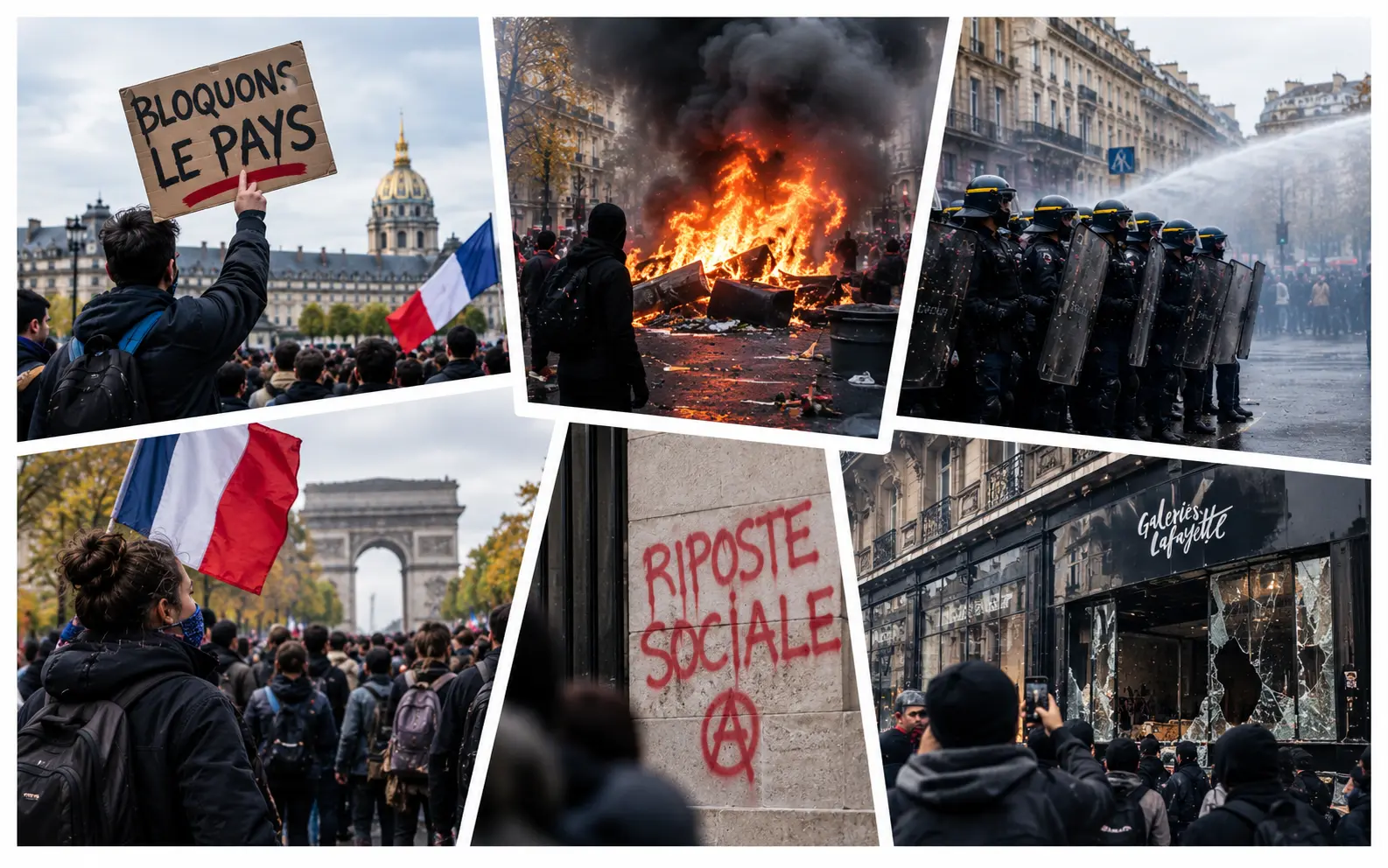
France Protests Update: Limoges Town Hall Fire, a Movement That Has Widened, and What It Means for International Students ?
17 October — National Protest Day
| Protest Date |
Reported Turnout |
Arrests |
Police and Gendarmes Injured |
|
17 October
National protest day
|
550k–800k
Interior Ministry vs. organisers
|
~1,200
According to the Prime Minister
|
150+
Police officers and gendarmes
|
If you saw news of a burning building in France, it was Limoges City Hall on the evening of Saturday 17th October. It happened during a nationwide day of protest that students and high school pupils joined, alongside unions, former gilets jaunes and others. This article does not repeat the background in our 9th October explainer. It covers what has happened since, and it says clearly where sources disagree or where we could not confirm a detail.
Important
The situation is changing daily. Check your university's official channels and your embassy's advice before you travel on a protest day. This article is information, not legal advice.
1. What happened on Saturday 17th October ?
Hundreds of thousands marched, mostly peacefully, in a day that organisers framed around the cost of living. Violence broke out in the evening in several cities. The table gives what outlets reported, city by city.
Reported Incidents by City
| Place |
What Was Reported |
Sources |
| Limoges |
City Hall was set on fire. Reports described attackers
breaking windows and starting a fire on the ground floor.
The flames spread to the roof of the left wing, and the
campanile reportedly collapsed. The prefect described the
building as largely lost. No injuries were reported in Limoges.
|
Includes AFP reporting and imagery
|
| Lyon |
A branch of the city's tourism office was vandalised and
set on fire during the protests.
|
|
| Marseille and Lille |
In Marseille, protesters forced their way into City Hall
and damaged the entrance hall. One person spray-painted an
anarchist “A” symbol before police intervened.
The linked reports support the Marseille incident; verify
the separate Lille details against a Lille-specific report.
|
|
| Bordeaux |
The prefect's residence was reportedly forced open and
ransacked. Reports also described widespread disorder,
looting and fires in the city centre.
|
Sud Radio link opens its news page
|
| Paris |
Police used water cannons and tear gas. Shops and banks
were smashed or looted, an attempt was made to enter
Galeries Lafayette, and a car burned at Place de la République.
|
|
| Saint-Étienne |
A 17-year-old reportedly lost a hand when a police grenade
exploded. Early accounts cited by AFP said he had picked
up the grenade. The case was referred to the IGPN police
inspectorate.
|
|
The Limoges building was inaugurated in 1883 and is protected as a historic monument for its facades, roofs and fountain (Orange, citing local reporting). Mayor Guillaume Guérin said it was "a monument burning, but not the Republic" and that prosecutions would follow. One outlet gave a different construction date, so we use the one tied to the monument listing.
Tip
Earlier reports on 17th October gave lower counts, for example about 400 arrests. The Prime Minister's later figure was 1,200. "Interpellations" means people detained, not people charged.
2. The latest figures
Numbers differ by source. We show each body's own figure and do not choose between them.
17 October: Key Figures
| Measure |
Official / Government |
Other Sources |
| 17 Oct turnout |
About 550,000, according to Interior Minister Nuñez, as
reported by Entrevue; 110 demonstrations.
|
800,000, according to the CGT, as reported by AFP.
|
| 17 Oct arrests |
About 1,200, according to Prime Minister Lecornu late
Saturday night.
|
Not applicable |
Protest Statistics: Wider Context
| Measure |
Official / Government |
Other Sources |
| 17 Oct police injured |
150+ police officers and gendarmes, according to
Prime Minister Lecornu.
|
No national total for injured protesters found.
|
| 13 Oct turnout ("Act V") |
161,500, according to government figures. |
480,000, according to unions. |
| Universities disrupted, 13 Oct |
About 35% of establishments, according to the government.
|
90% blocked or closed, according to Union étudiante.
|
| Schools partly burned, since the start |
37 establishments, according to Education Minister Geffray.
|
Not applicable |
| Injured since the start |
Nearly 900 police officers and gendarmes and 200+ pupils,
according to the Interior Ministry; 165 education staff,
according to Education Minister Geffray.
|
Not applicable |
| Police oversight inquiries |
36 IGPN investigations, including 4 for mutilating injuries
and 6 for significant injuries, according to AFP.
|
Not applicable |
Two things stand out. School disruption was easing before 17th October, the Education Ministry said about 4% of establishments were closed on average on 16th October, though it has stopped publishing the number of disrupted schools. But violence has risen, and Lecornu described the movement on 15 October as a "mouvement de violences urbaines".
3. How the movement has changed ?
The 9 October movement was about schools and universities. By 17th October it had merged with a cost of living protest that began online in early September, first through the gilets jaunes. According to Euronews, the day drew:
• Unions: the CGT, Solidaires, the VTC drivers' intersyndicale and the Confédération paysanne (the FNSEA did not join)
• Parties: La France insoumise et the Parti communiste français. The Parti socialiste also called for a demonstration
• Student and youth groups: the USL, the Union étudiante and the FAGE, plus climate-march organisers and "Bloquons tout" collectives
The government and opposition now read the violence differently. Lecornu blamed the far left ("ultragauche"). Entrevue notes that this is a political attribution and does not establish who set which fire. Macron said those responsible would be "prosecuted and punished". Gérald Darmanin asked that pre-trial detention be sought against suspects accused of attacking police, firefighters, public buildings and shops. Jean-Luc Mélenchon backed the student protests and marched. The mayors of Paris, Marseille and Lyon asked to meet the Prime Minister early in the week of 19th October.
4. The new demands
These are demands that were not in our 9th October list, or that have been sharpened since.
Key Demands and Who Is Calling for Change
| Demand |
Who Is Asking |
Source |
|
Scrap Parcoursup, the university application platform
(the union calls it a selection platform)
|
USL; Jean-Luc Mélenchon |
Publication homepage; exact article not verified.
|
|
Raise wages and purchasing power, and tackle fuel,
energy and food prices
|
Gilets jaunes, CGT and the 17 October coalition; PS |
Euronews links to its report on the 17 October mobilisation.
|
| Fund education and health, and act on climate |
The 17 October coalition |
|
| End police violence, with investigations into injuries |
The 17 October coalition; families of injured teenagers
|
|
| Stop "abusive" administrative closures of universities |
Higher-education intersyndicale |
Publication homepage; exact article not verified.
|
| Match replacement teachers to the subjects that are short |
SNES-FSU |
Publication homepages; exact articles not verified.
|
| A strike and demonstration on 5 November |
CFDT, CGT, FO, UNSA and FSU |
Révolution Permanente is a partisan outlet.
|
| Return-to-class mobilisation on 2 November |
Les Lycéens! |
Publication homepage; exact article not verified.
|
The CGT leader, Sophie Binet, said the demands of gilets jaunes, farmers and VTC drivers "join" those of young people. The USL, Les Lycéens! and Renouveau lycéen all said the government's announcements did not answer their grievances on buildings, Parcoursup and timetables.
5. What has changed so far ?
We separate what is in place from what has only been announced.
Government Response: Measures and Status
| Measure |
Status as Reported |
Source |
| 3,000 replacement teachers for the worst-hit lycées |
Announced on 8 October. About 2,000 assigned by 16 October.
Geffray said schools with serious teacher shortages fell
from 114 to 41 in a week.
|
|
| About 1,000 contract staff |
Being recruited. About 100 hired by 13 October.
|
Related report; the specific Yahoo Actualités article
was not independently verified.
|
| Online consultation of pupils |
Nearly 100,000 contributions by 15 October. Matignon said
about three-quarters mention overloaded timetables and
half mention buildings.
|
|
| Stun grenades |
Suspended for the high-school movement since 7 October.
Nuñez said they could be used again for "extremely serious
urban violence".
|
Publication homepages; exact articles not verified.
|
| Budget 2027 |
Lecornu said the government would table amendments taking
up "some proposals". No detail yet.
|
|
| Parcoursup |
The government is open to changes and more guidance support
but rules out scrapping it. Concrete measures are due at
the end of October.
|
|
Cost of Living and Public Order
| Measure |
Status as Reported |
Source |
| Cost of living |
A decree extended €100 aid for heavy drivers to the end
of the year, and aid to road hauliers was being accelerated.
|
Publication homepage; exact article not verified.
|
| Public order |
Paris police banned demonstrations around the Élysée,
Matignon and the Champs-Élysées. An interministerial
crisis cell was set up.
|
Publication homepage; exact article not verified.
|
As of 16th October, La Libre reported no new concessions from the Education Minister beyond the emergency replacement-teacher plan. The CGT called the announcements "cosmetic". The 17th October violence came after that.
6. What is happening in universities ?
• Students are not on holiday next week. Schools break for the Toussaint holidays, but many university students have exams (partiels), so participation in action days is uncertain (AFP).
• A higher education intersyndicale has condemned what it calls abusive administrative closures (La Libre). Closures are decided locally, so notices come from your own university.
• The national medical exams (EDN) ran from 12th to 15th October. The deans said they were maintained, and 16th and 19th October were reserved for any rescheduling (L'Étudiant).
7. How this affects international students?
We found no official announcement of changes to visas, residence permits, Campus France procedures or the fee rules linked to the protests. The effects are practical. Our 9th October checklist on documents and attendance still applies, and the points below are the new ones.
• Safety on action days: 17th October showed that violence can start late in the day, after a calm march. Avoid city centres on protest days, especially Saturdays and 5th November, and follow police cordons. Paris police have banned protests in certain central areas.
• Shops and transport: Shops were looted in Paris, Lille and other cities. Expect closures and detours near march routes in the evening.
• Exams and classes: If your university closes administratively, ask for the official notice and the new exam date in writing. Do not assume a missed exam will be rescheduled.
• Legal risk: Police detained about 1,200 people on 17th October, and ministers have called for prosecutions. If you are stopped or detained, stay calm, give your identity, and ask for a lawyer or contact your embassy.
• Parcoursup: It is the national platform for applicants with a French or European baccalaureate. Most non-EU students abroad apply through Campus France's Études en France and the DAP, whose 15th January 2026 deadline has not changed in anything we found. Debates over Parcoursup are not about your route.
• Fees: The Union étudiante opposes the fee rise for foreign students, but the law is unchanged. Our guide to the 2026–27 fees has the current amounts.
• Embassy advice: We did not find a new advisory from the Indian or other embassies about these protests. Check your own embassy's website, and register with it if it offers that.
Warning
Foreign nationals are subject to French law like everyone else. Do not take part in blockades, or in gatherings that turn violent. We found no source on how an arrest would affect a particular permit renewal, so get legal advice about your own situation.
8. What is next ?
Upcoming Dates and Developments
| Date |
Event |
Source |
| Week of 19 Oct |
Mayors of Paris, Marseille and Lyon ask to meet the Prime
Minister. Many universities hold exams.
|
|
| Mon 2 Nov |
Les Lycéens! calls for mobilisation on the return to school.
|
|
| Thu 5 Nov |
Day of strike and demonstration called by CFDT, CGT, FO,
UNSA and FSU.
|
|
| End of Oct |
Parcoursup measures and the funding timeline the government
has promised.
|
|
Frequently asked questions
1. Which building was burned down?
Limoges City Hall, on the evening of 17th October. The prefect said it was largely lost. No injuries were reported there.
2. Are universities closed?
Some are, but closures are local. The government said about 35% of establishments were disrupted on 13 October, while the Union étudiante claimed 90%. Check your own university.
3. Are international students being targeted?
We found no source saying so. The risk is disruption and being caught near violence.
4. Will my visa or residence permit be affected?
We found no announcement of any change. Keep your enrolment documents and follow the rules.
5. When is the next big day?
Thursday 5th November, called by five union confederations, with a lycéen call for 2th November.