
Discover France
Student Housing in France 2026: Every Option for International Students
No Housing in France Yet? Every Option That Works for International Students (2026)
Most French universities do not house their own students. Housing comes from a mix of a public network (the Crous), a few special residences, private operators and the ordinary rental market. That is why students who only apply to one of them end up stuck. This guide covers all of them, then tells you which to try first.
In short
Apply to the Crous before 29 October 2026, and at the same time to at least one private student residence and one platform listing. If you are in a master's or PhD in Paris, add the Cité Universitaire. Sort your guarantee early (Visale or a platform guarantee). Book a hostel for the first week so you never pay a stranger in a hurry.
1. Public and school dorms
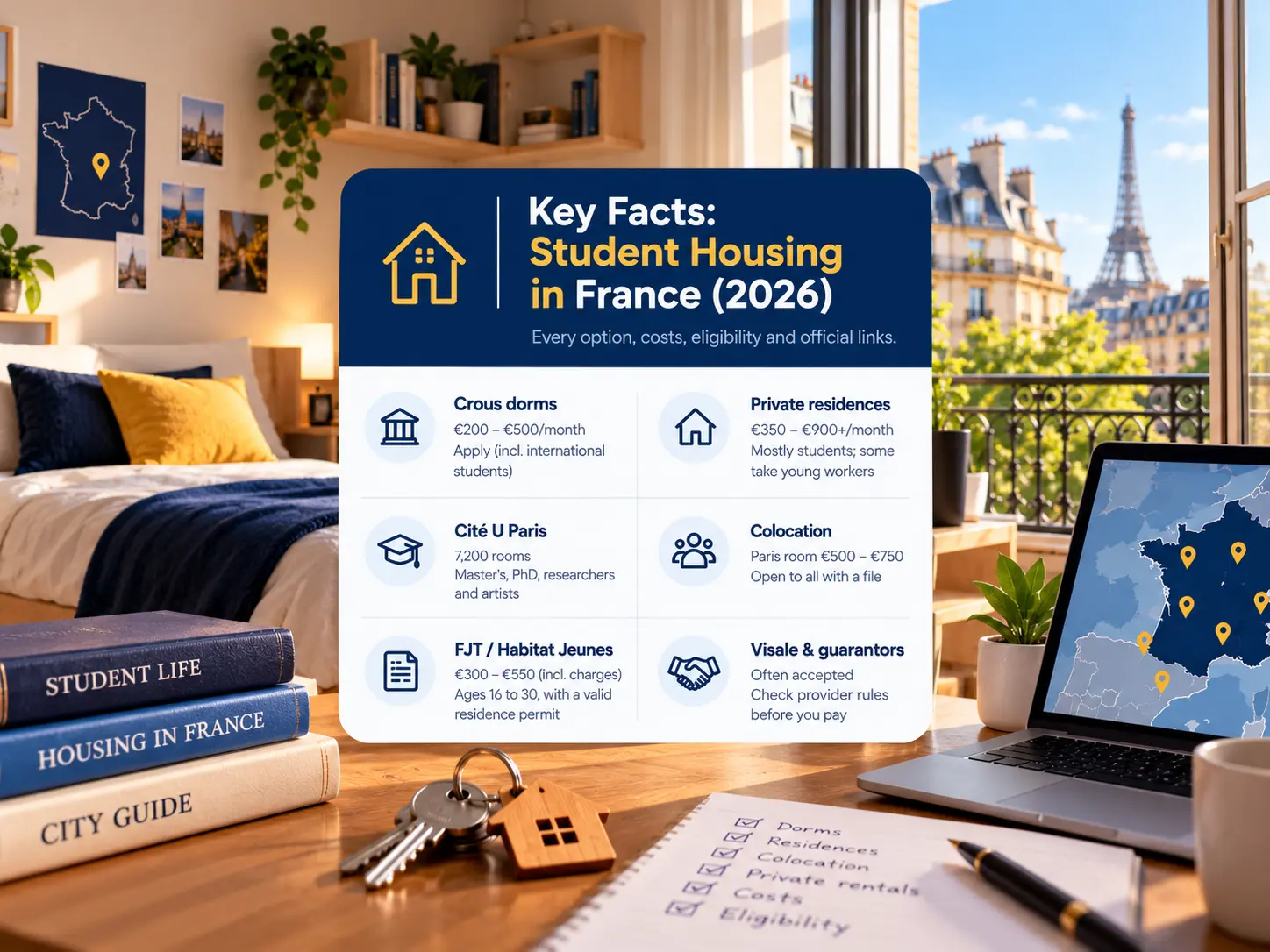
Crous residences are the regulated, low cost dorms. Traditional rooms and studios of 9 to 20 m² cost about €200 to €500 a month (Service-Public). International students cannot use the main allocation (5 May to 29 June 2026), because they generally cannot file the Dossier social étudiant. Your route is the complementary phase, open 7 July to 29 October 2026 at trouverunlogement.lescrous.fr. You can list up to 10 wishes and rooms appear as others withdraw, so check daily. If you get an offer, confirm within 48 hours by paying the advance on rent (€70 on the ministry page, €100 on Service-Public; deducted from the first rent). Rules vary by Crous: Crous Bordeaux, for example, limits free-mover housing to master's and doctoral students. We could not confirm whether every Crous takes new requests after 29 October, so ask yours.
Cité internationale universitaire de Paris (CIUP): About 7,200 rooms in 47 houses in the 14th arrondissement. It admits master's and PhD students (Bac+4 or equivalent) enrolled in Île-de-France, plus researchers and artists. Bachelor's students are not eligible. Apply only online at ciup.fr. There is no deadline and new residents are accepted all year, but September requests should be completed in April, and if you have no offer 15 days before your arrival date the application was not accepted. The CIUP does not publish rents on its application page, so check the house you want.
Your school's own housing: Some institutions, especially grandes écoles, run or reserve their own residences. Ask your admissions or international office before you search elsewhere; this is also the fastest way to get a bed if the school has reserved rooms.
2. Private student residences: dorm comfort, market prices
Private residences are the closest thing to a dorm with services: a furnished studio with its own bathroom and kitchenette, often with laundry, bike storage, a common room and sometimes internet. Operators named in the sources include Nexity Studéa, Les Estudines, Fac-Habitat, Suitétudes, Studélites, Neoresid, Sharies, Zenitude, Logifac, Kley, Twenty Campus and Student Factory. The terms are those of a normal lease (usually 9 or 12 months), with a deposit of about one month's rent. Some charge entry fees (often €200 to €300 in an older L'Étudiant article), and charges, electricity, insurance and taxes can be extra. Booking early matters because residences near campuses fill fast.
3. Private rentals, colocation and Studapart
Dimensions France works with Studapart, a student housing platform. It says it covers 45 French cities plus Brussels, with more than 180,000 listings from over 70,000 owners (press release, 9 July 2026). You can book before the lease is signed: you pay the booking fee (€179 to €500, depending on city and housing type) and the first month's rent online, and the rent reaches the owner 24 hours after your move-in date. Owners have 24 hours to accept a request. Platforms like this ask for your ID and tenant file to verify you, which is normal.
The deposit is normally paid to the owner directly at move-in, or to the agency if the agency manages the flat. Some owners ask for it when they send the booking proposal. That can be normal, but keep it on the platform: get the amount and terms in writing, pay by traceable transfer (never cash) and keep the receipt.
Other places to search: Lokaviz is the Crous run platform for rooms and flats from private owners, and some listings are checked by Crous teams for decency, energy and rent transparency. You can browse freely, but you need an account with proof of enrolment to contact a landlord. For shared flats, the ministry lists La Carte des Colocs, WeShareWeCare, Immojeune and Appartager. A room in a shared flat in Paris is about €500 to €750 a month, and a studio €600 to €950 (CIUP Access guide, 2025). Whatever you use, sign a lease before you pay a deposit.
4. Youth residences (FJT / Habitat Jeunes)
Foyers de jeunes travailleurs are furnished residences for ages 16 to 30, open to apprentices and young workers and, in many cases, students. They are not only for French nationals: non-French applicants need a residence permit (carte de séjour). Costs run about €300 to €550 a month charges included (ImmoJeune, April 2026); the CIDJ says the monthly fee covers rent of roughly €250 to €500 plus services such as linen, internet and sometimes breakfast. Expect a deposit of one month's rent, about €50 in file fees and about €15 for a key card. Some will rent a single room by the month without meals. Apply directly to each residence through the Habitat Jeunes (UNHAJ) or ALJT networks, and apply to several: places are limited and most intake is planned months ahead. Student admission rules differ by residence, so ask. The 2026 APL change below applies to FJT residents too.
5. Cheap and solidarity housing
• KAPS (Afev): A room in a shared flat in a working-class neighbourhood for €150 to €400 a month, all charges included (before APL), in exchange for a few hours a week of community activity such as mentoring children. For students and young people under 30. Details at afev.org.
• CoopColoc: (Île-de-France and Nouvelle-Aquitaine) rents furnished social housing flats to students through an association, and Ma1son combines shared housing with a citizen project. These and other solidarity schemes are described by an older L'Étudiant article as "exceptional", with few places a year, and some are reserved for scholarship holders. Apply early.
• Intergenerational housing: You share a home with an older person. In the solidarity formula the rent is very low, often €50 to €200 a month, in exchange for presence and small services; in the classic formula it is a normal room rent of up to about €400 (ImmoJeune, April 2026). Associations include Ensemble2Générations, Le Pari Solidaire, Habitat et Humanisme, Colette and Cohabilis, and WeShareWeCare targets international students. Always sign the lease and the services agreement in writing, never verbally.
6. A bridge stay for the first week
Even with a plan you may need a bed for a few nights. The CIUP Access guide for Paris lists youth hostels (HI Paris d'Artagnan and Yves Robert, BVJ, FIAP Jean Monnet), international stay centres (CISP), the MIJE houses in the Marais (limited to 7 days), and budget hostels such as Generator, St Christopher's and The People. It gives no prices, so compare on each site. BVJ takes cash only and the AIJ has a 30 year age limit.
Outside Paris, HI France lists other hostels. If you truly have no shelter tonight, call 115, the free national emergency line open 24 hours a day.
At a glance: which option for whom
Which route fits you? (our advice)
• Master's or PhD in Paris: apply to the CIUP now, and to the Crous, in parallel.
• Bachelor's student with no guarantor: Visale if you qualify, or a platform guarantee, then a private residence or Studapart booking.
• Tight budget: try KAPS, intergenerational housing, an FJT or a shared flat, and apply to the Crous as a backup.
• Social-criteria scholarship holder: Crous housing is your best value, and you keep APL.
• Landing soon with nothing booked: book a hostel for a week and apply to three or more options at once.
Guarantee and money help
• Visale (visale.fr): free guarantee from Action Logement for ages 18 to 30, enrolled in a post-secondary institution in France. Non-EU students need a visa or permit with the mention "Étudiant". Rent cap without income proof: €800 in Île-de-France, €600 elsewhere. Valid 6 months; the Crous accepts it. Request it before you sign.
• Studapart Guaranteed Profile: for students without a guarantor. €249 to €459, valid 6 months, non-refundable, only on Studapart and only for housing in France.
• Avance Loca-Pass: (Action Logement): an interest-free loan of up to €1,200 toward the deposit, repaid over up to 25 months after a deferral of up to 3 months. Ask within 2 months of moving in. Students qualify with a state scholarship, or a fixed-term contract or internship of at least 3 months. The rules we found do not state nationality conditions, so confirm with Action Logement.
• APL (CAF) since 1 July 2026: non-EU students on a student visa or permit now get it only with a social criteria scholarship. Exceptions: paid work (including self-employed), apprentices and professionalisation contracts, refugees, stateless people, spouses of non-EU students, and EU/EEA/Swiss nationals. Budget your rent without APL unless you are in an exception. Losing APL does not end your lease, so you still owe the rent (Kohen Avocats). Check at caf.fr.
If money runs out: the Crous social service can give a one off grant (aide ponctuelle) after a social assessment, and Crous restaurants charge €1 for scholarship holders and students in hardship (Crous Normandie; international students can ask for the €1 rate after a social assessment).
Rental scams: red flags
New arrivals are targeted because they search from abroad or in a hurry. The government's cybercrime agency and Service-Public list these signs:
• A price far below similar listings, or photos that appear in other ads
• An owner who "lives abroad", cannot meet and wants everything done remotely
• A request for a deposit or reservation fee before a visit or signed lease
• Payment by Western Union, MoneyGram, Neosurf, Transcash, cash or a foreign account
• A private advertiser who asks for your ID, payslips or tax notice before any visit and outside any platform, or who sends a link or QR code to a "secure payment" page. (Uploading documents to a booking platform's tenant file is normal; only do it on the platform's own site, never by email or chat.)
If you have paid, contact your bank immediately, keep screenshots and messages, and report it on THESEE via Service-Public or at a police station. The free Info Escroqueries line is 0 805 805 817 (Monday to Friday, 9:00 to 18:30).
Frequently asked questions
1. Can I still get Crous housing after 29 October?
The complementary application phase ends that day. Crous Normandie tells students to keep checking the site after 30 October. Ask your own Crous whether new requests are accepted.
2. Can I book before I arrive?
Yes. On a platform like Studapart you can book before the lease is signed, with the booking fee and first month's rent paid online. Never wire money to an individual.
3. Can I live in the Cité Universitaire as a bachelor's student?
No. It admits master's and PhD students (Bac+4 or equivalent), researchers and artists, mainly in Île-de-France.
4. Which option is cheapest?
Usually solidarity or intergenerational housing, KAPS (€150 to €400 all-in) or a Crous room (€200 to €500), but these have limited places and conditions.
Need help with this?
Tell us where you are and we’ll point you to the right service, with a fixed price and a clear list of what’s included.
Book a call