
Book a call

Discover France

France's RIPOST Law Explained: What Changed for Students?
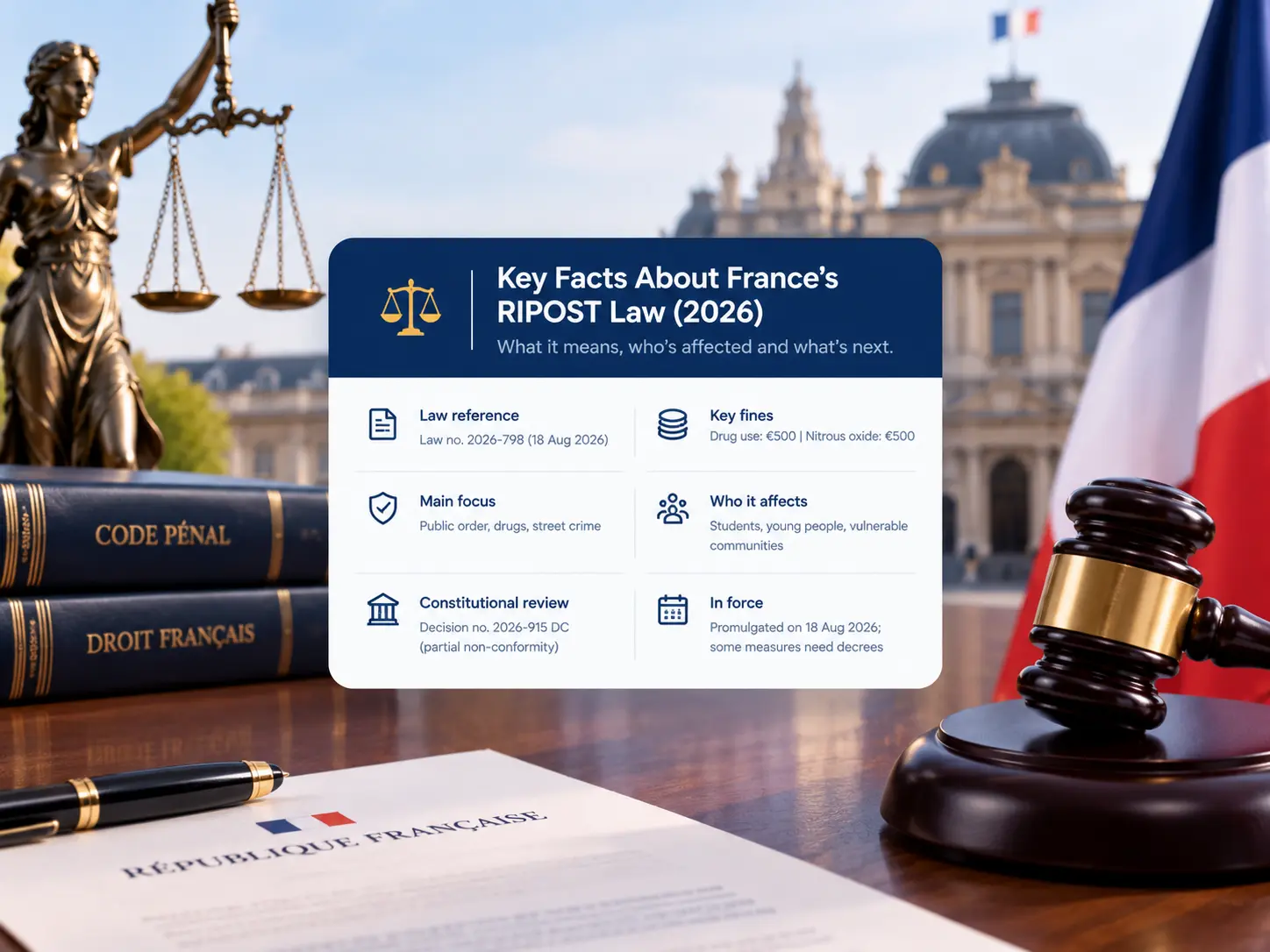
The RIPOST law (Law no. 2026-798 of 18 August 2026) bundles dozens of measures on street nuisance, drugs, organised crime and policing tools. This guide explains what it contains, how it passed, what the Conseil constitutionnel struck down, what critics say, and what international students should know.
October 21, 2026
France's RIPOST Law Explained: What Changed for Students?

What Is the RIPOST Law? France's New Public Order Law Explained for International Students

RIPOST Law: Key Dates and Figures
Promulgation Final Vote Fixed Fine Nitrous Oxide Restrictions
18 Aug 2026 Law promulgated 351–179 Final National Assembly vote €200 → €500 Fixed fine for illicit drug use 1 Feb 2027 Restrictions on nitrous oxide sales and supply to individuals take effect, subject to legal exceptions

You may have seen the name RIPOST in the news or on social media. It is a French law that Parliament adopted in July 2026 and that became law on 18 August 2026. Its official title is the law "visant à offrir des réponses immédiates aux phénomènes troublant l'ordre public, la sécurité et la tranquillité de nos concitoyens", which means "to offer immediate responses to phenomena disturbing public order, security and tranquillity". RIPOST is the short nickname. 

‍

It is not one rule. It is a package of measures on very different subjects, from illegal raves and nitrous oxide to drug fines, motorised street racing and police surveillance tools. This guide sets out what the final law contains, using the Journal officiel text and official and press reporting. It is information, not legal advice.

‍

In short

‍

RIPOST was presented by Interior Minister Laurent Nuñez on 25 March 2026, adopted by Parliament on 21–22 July, partly struck down by the Conseil constitutionnel on 14 August, promulgated on 18 August and published on 19 August 2026. Supporters call it a "choc d'autorité" for everyday order. Critics, including the Defender of Rights, warn about surveillance and civil liberties.

‍

‍

1. The law at a glance

Law at a Glance
Item Answer
Official reference Law no. 2026-798 of 18 August 2026, published in the Journal officiel no. 192 on 19 August 2026.
Minister behind it Laurent Nuñez, Minister of the Interior.
Structure Three titles covering street nuisance and everyday delinquency; narcotrafficking and organised crime; and the adaptation of enforcement tools.
Constitutional review Decision no. 2026-915 DC of 14 August 2026: partial non-conformity, with reservations.
Status today Promulgated. Some measures apply immediately, while others require implementing decrees or technical arrangements. A further measure is scheduled for 1 February 2027.

‍

‍2. How it became law?

Legislative Timeline
Date (2026) Step
25 March Bill presented to the Council of Ministers and filed in the Senate under the accelerated procedure.
26 May The Senate adopts the bill at first reading.
15 July The National Assembly adopts the bill at first reading, following debates held from 7 to 10 July.
20 July The joint committee (CMP), comprising members of both chambers, reaches an agreement on the text.
21 July The Senate adopts the agreed text. The National Assembly gives final approval that evening, with 351 votes in favour and 179 against.
24 July At least 60 deputies refer the law to the Constitutional Council for review.
14 August The Constitutional Council issues Decision no. 2026-915 DC.
18 August The law is promulgated as Law no. 2026-798.
19 August The law is published in the Journal officiel.

‍

3. What the law does?

The table covers the measures most likely to affect daily life. Figures come from the final law as reported after promulgation. We mark any detail we could not confirm.

Key Measures: What Changes
Topic What Changes
Illegal raves (free parties) Organising an illegal music gathering is punishable by up to 2 years in prison and a €30,000 fine, with confiscation of equipment. Taking part is punishable by up to 6 months in prison and a €7,500 fine, or a €500 fixed fine imposed on the spot. The threshold for declaring a gathering to the prefecture falls from 500 to 250 people.
Nitrous oxide ("proto") Inhaling nitrous oxide outside a medical setting becomes an offence, punishable by a €500 fixed fine. Selling it to individuals is banned from 1 February 2027. Prefects can temporarily close shops that sell it for misuse.
Drug use The fixed fine for drug use rises from €200 to €500. Licence suspension can be imposed as a complementary penalty. Drug-driving rules are also tightened.
Motorised street racing (rodéos) Offenders can face a fixed fine and easier vehicle confiscation. A new offence also covers prohibited motorised gatherings, including "rodeo", "run" or "tuning" events.
Mortar fireworks Carrying or possessing mortars without a legitimate reason can carry up to 3 years in prison and a €45,000 fine, compared with the previous maximum of 6 months and €7,500.
Policing tools Automated number-plate reading is extended to more offences, while facial recognition is excluded. The algorithmic video-surveillance experiment introduced for the 2024 Olympics runs until 31 December 2030 and can cover additional locations.
Identity checks The law widens identity, vehicle and luggage checks around borders, ports, airports and stations. See the article's dedicated section for details that could not be confirmed.
Tip: Several measures need implementing decrees or technical systems before they work in practice. The gendarmerie says the fixed-fine systems need several months of development, while the border-check rules require a Conseil d'État decree.

‍

4. What the Conseil constitutionnel struck down?

‍

The Council, referred by deputies, validated most of the law but removed or limited several provisions. These are the points confirmed by the decision or by at least two sources. 

‍

Struck down 

‍

• Closure of shops selling explosives or fireworks, and an on the spot fine for illegal possession or supply of fireworks 

• A penalty for driving a "powerful vehicle" in the probationary period, because the power threshold was left to regulation 

• Destruction of vehicles used in rodeos without letting owners claim them first 

• Duplicate offences for unlawful stays in holiday rentals

• Provisions to make it easier to pseudonymise police and gendarmerie officers in criminal proceedings, for breaching the rights of the defence 

• Five articles removed as legislative riders with no link to the original bill, including tougher penalties for tobacco trafficking and street selling 

‍

Allowed only under conditions 

‍

• Renting amplified sound equipment can be banned only for gatherings that must be declared

• Stadium-related bans must respect the person's home and work life and last no more than 24 hours

• Evicting squatters from commercial, farm or professional premises applies only where nobody has made their home there 

• Algorithmic video surveillance in certain buildings open to the public is capped at three renewable months 

‍

On 19 August, Nuñez said he had asked his services to draft new wording that meets the Council's requirements and extends pseudonymisation of police and gendarmes. 

‍

‍

5. Support and criticism 

‍

Nuñez described the law as a "choc d'autorité et choc d'efficacité" that gives the forces of order more effective tools. Reactions differ across the political spectrum, and we report each as a position, not a fact. 

Key Positions and Reactions
Who Position
Interior Minister Says the law targets offences that are "increasingly offensive" and equips police with better tools.
La France insoumise Argues that the law undermines the rule of law and civil liberties, and disproportionately affects young people, poorer and racialised communities, and Travellers.
Rassemblement national Described the text as a "fourre-tout" (catch-all) and criticised both the left and the government on security, while voting in favour of the bill.
Defender of Rights (Claire Hédon) In an opinion dated 16 June 2026, raised objections to the identity-check provision, citing insufficient judicial oversight and risks of arbitrary or discriminatory checks.
La Quadrature du Net Criticised the proposed extension of automated number-plate reading as mass surveillance, based on the bill as debated in June 2026.

The Conseil d'État had also warned, in an opinion of 19 March 2026, against piling up police measures that significantly restrict freedoms. These views explain why the law is widely described as controversial. 

‍

‍

7. What this means for international students?

‍

RIPOST is a criminal and public order law. None of the sources we reviewed describe it as changing visa or residence permit rules. It applies to everyone in France, and the points below are the ones most likely to matter on a student's evening out. 

‍

‍

• Drug use: an on-the-spot fixed fine is now €500, up from €200. 

‍

• Nitrous oxide: inhaling it outside a medical setting is now an offence, and the ban on selling it to individuals starts on 1 February 2027. 

‍

• Parties and events: organising or attending an illegal rave carries penalties. If you plan a large event with amplified music, check the declaration rules, since the threshold is now 250 people.

‍

• Identity checks: carry a form of ID. This is our advice, not a rule we have verified in the final text.

‍

• If you receive a fine or a summons: ask your university's student services or a lawyer what it means and what deadlines apply before you act. 

‍

‍

Frequently asked questions 

‍

1. What does RIPOST stand for? 

It is a nickname for the law "visant à offrir des réponses immédiates aux phénomènes troublant l'ordre public, la sécurité et la tranquillité de nos concitoyens". 

‍

2. Is the RIPOST law in force? 

It was promulgated on 18 August 2026 and published on 19 August. Some measures need decrees or technical systems, and the nitrous oxide sales ban starts on 1 February 2027. 

‍

3. Did the Conseil constitutionnel reject the law? 

No. It validated most of it but struck down several provisions and added reservations on others. 

‍

4. Is nitrous oxide banned in France? 

Sales to individuals will be banned from 1 February 2027, and inhaling it outside a medical setting is an offence under the law.

‍

5. Does the law target foreigners or students? 

The sources we reviewed do not describe it as aimed at foreigners. It applies to everyone, though critics say some measures could affect certain groups more than others. 

‍

6. Where can I read the official text? 

On Legifrance, as Law no. 2026-798 of 18 August 2026.

‍

Dimensions France

Questions About Living or Studying in France?

Our advisors help international students with applications, documents and settling in France, so you can navigate your study-abroad journey with greater confidence.

Contact Dimensions France
Dimensions France

Also Read

‍

Need help with this?

Tell us where you are and we’ll point you to the right service, with a fixed price and a clear list of what’s included.

Book a call

Keep reading

More guides.